


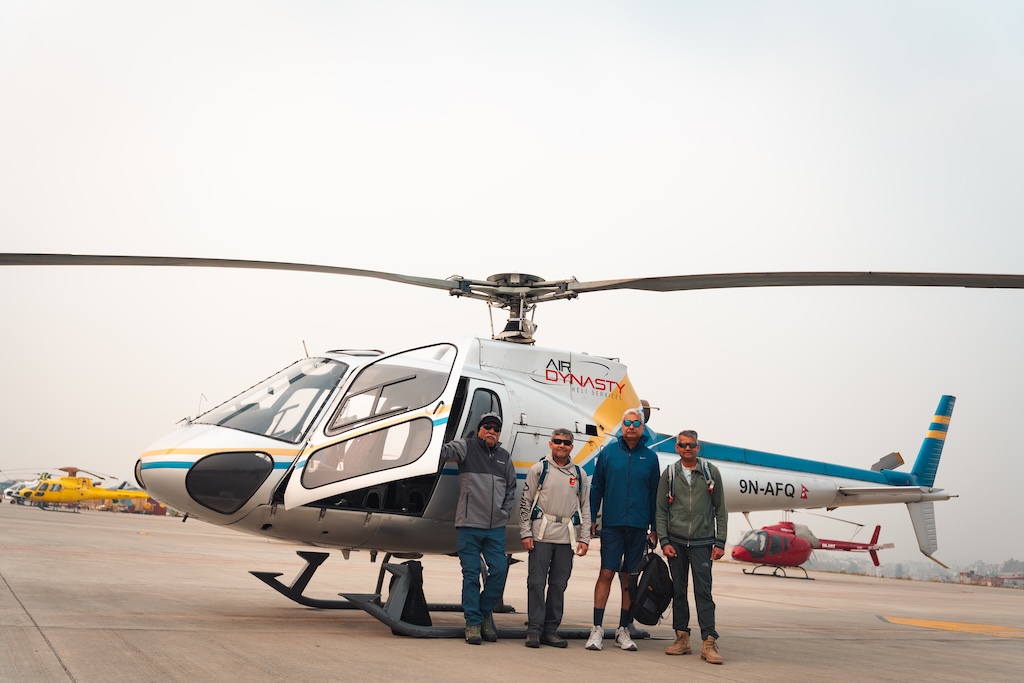


Everest Base Camp Helicopter Tour: Private or Group Joining?
Private (chartered) and group joining are the only available Everest Helicopter Tour options. It’s up to you to decide which one best fits you. To assist you, we’re giving you the idea of these two tour styles and let you find the best one for you.
Private (chartered) helicopter tour of Everest
If you’re planning an Everest Helicopter Tour with family or friends, and altogether, you’re a group of 4-5 people, achartered helicopter tour to Everest is the best. Why?
- can fly with the family and create a lifelong memory
- private space
- flexibility to tour to other regions like Gokyo Lakes
- everyday departure (given fair weather conditions)
Group Joining Everest Helicopter Tour
If you’re an individual or a couple who wants to tour Everest on a helicopter by sharing the tour price, the group joining a helicopter tour to Everest is best. The maximum number of people in the group joining the flight is five. And in five, when the Everest Base Camp Helicopter Tour Price gets split, one has to pay USD 1350, which is highly affordable.
The cons of group joining flights are:
- inflexible
- have to wait for a group to fill the quota of five people
- no private space during the flight
However, flying with groups is a great way to know people with similar travel appetites.
Best time for Everest Helicopter Tour
Everest Base Camp Helicopter Tour is about the beautiful aerial sightseeing of the world’s highest mountains. Moreover, the helicopter tour operates only in perfect weather conditions. Thus, for a wholesome Everest experience, you must plan this tour in the best months, in Autumn and Spring.
Autumn: September-November
Autumn months start in September and end in November. As it still rains in September, the helicopter tour to Everest however gets busier from its last week. The weather becomes stable with less overcast. Also, with almost no rain, the helicopter tour barely gets canceled or postponed.
With rain-washed landscape, even the high altitude landscape appears green and lively. On the mountains, the thick snow deposit remains, making the aerial viewing more beautiful.
Spring: March-May
Like late Autumn, the weather in Spring remains clear and rain-free. Hence, the helicopter tour to Everest operates smoothly throughout the Spring.
Particularly, March is the best month to fly if you want to experience the snow-occupied landscape of the Everest region. With fair weather comes greater visibility. The mountain panorama looks elegant, leaving you in awe.
Also, in March and April, finding group joining flights is easy. With more travelers wishing to fly, you’ll get the departure groups easily.
Winter: December-February
If you want Everest Helicopter Tour in winter, it’s also a good time to tour. Flying in a helicopter, you’ll escape the cold.
Everest region in winter becomes a snow wonderland. And from Kala Patthar, you’ll see Mt. Everest, Lhotse, Nuptse, Pumori, and Changatse, all in deep snow.
Temperature at Everest Base Camp
Helicopter tours to Everest usually happen during the morning, before 10 am. Hence, you can expect a drop in temperature while landing at Kala Patthar.
In Spring, the morning temperature at Everest Base Camp averages to -7˚C. Similarly, in Autumn, the morning temperature drops to -10˚C. The temperature in winter falls below -15˚C at the base camp and Kala Patthar.
Here’s a table that gives you an idea of the temperature at Everest Base Camp during each season (average).
|
Months |
Average morning temperature |
| March, April, May |
-7˚C |
|
September, October, November |
-10˚C |
| December, January, February |
-15˚C |

Everest Base Camp Trek or Everest Base Camp Helicopter Tour with Landing in 2024?
You may wonder whether to plan 12-day Everest Base Camp Trek or a four-hour Everest Helicopter Tour in 2024. The confusion is obvious because the ultimate destination on both the trek and tour is to reach the base camp of Everest and view Mt. Everest and other highest mountains.
However, there are distinctive elements that make the difference significant. Not everyone can trek, but everyone can fly on a helicopter.
Here are some comparisons between EBC Trek and Everest Helicopter Tour.
Time Commitment: Trekking vs Helicopter Tour
In short, Everest Base Camp Trek can take up to 14 days to complete. On the contrary, the helicopter tour of Everest finishes in four hours. It explicitly shows that for trekking, one must have adequate time.
Typically, on EBC Trek, you’ll start the walk from Lukla. You’ll trek gradually with two acclimatization stops at Namche Bazaar and Dingboche. The gradual walk through Sherpa villages, diverse landscapes, and arduous glaciers provides a cultural and natural experience. Trekkers immerse themselves in the mountains, which ultimately fosters a sense of connectivity.
While on a helicopter tour of Everest, you’ll fly on a helicopter for four hours. During this, you’ll soar over Everest Base Camp and land at Kala Patthar for short sightseeing. You’ll enjoy the bird’s eye view of mountains and landscapes, which trekkers don’t.
If you’re ready to commit 12-14 days of trekking, you can plan the trekking. However, if you have time limitations and desire to see Mt. Everest up close, the shortest way is a one-day Everest Base Camp Helicopter Tour.
Physical Exertion: EBC Trek vs Everest Helicopter Tour
Everest Base Camp Trekking is challenging and demands physical fitness. Contrary to this, a helicopter tour to Everest is luxurious, comfy, and barely demanding.
The Everest Base Camp Trek Route starts from Lukla on an easy terrain. However, the uphill ascend to Namche on the second day is very tiring. In the coming days, you’ll experience a similar arduous uphill section to Tengboche. Another uphill section of Lobuche often causes extreme fatigue and altitude sickness.
You’ll traverse through uneven rocky terrain and the Khumbu glacier moraine. This section between Lobuche and Gorak Shep tests your endurance. Moreover, returning to Pheriche, Namche, and Lukla can be extremely tiring.
Due to all these, physical exertion makes the EBC trek challenging.
Sitting on the comfy seat of the helicopter, cherishing the bird’s eye view of beautiful mountains, and feasting the elegant breakfast at the world’s highest altitude seated hotel barely demands any physical exertion. The only events you’ll engage in physical activities are during the shuttle in Pheriche, Kala Patthar landing, and breakfast.
Accessibility
Due to physical exertion, EBC Trek is not everyone’s reach. However, with almost zero physical exertion, Everest Base Camp Helicopter Tour with Landing at Kala Patthar is accessible to everyone.
Who can join the Everest Base Camp Helicopter Flight Landing Tour? Here’s a list of potential travelers who can benefit from this comfortable luxury day tour.
- senior citizens below age of 90 years
- children over the age 5 years
- travelers with poor physical fitness
- people with physical mobility issues (disabled)
Altitude Sickness: EBC Trek vs Everest Base Camp Helicopter Tour
Trekking in high altitude over 5,000 meters altitude exposes trekkers to altitude sickness. Usually, two in ten trekkers on Everest Base Camp Trek get altitude sickness at some point in the trek and return without reaching the base camp.
On a helicopter tour, there’s no such thing as getting altitude sickness. However, we can’t rule out it completely, as you’ll reach 5, 645 meters. At this altitude, you’ll stop for 5 short minutes for sightseeing to avoid possible mountain sickness. Despite this, some experience difficulty in breathing. But, they benefit from the bottled oxygen in the helicopter that prevents getting altitude sickness.
With zero possibility of altitude sickness during the tour, it’s accessible and best fit for most travelers.
Packing list for Everest Base Camp Helicopter Tour
One great thing about the Everest Helicopter Tour is avoiding the extensive and expensive packing list for the Everest Base Camp Trek. Trekkers on EBC Trek pack almost 15-18 kg of trek gear, clothes, and other essentials. Contrary to the trek, the travelers on the Everest Helicopter Landing Tour carry a few pieces of gear on a light daypack.
A 10-litre capacity daypack is highly recommended.
Here’s a complete packing list for the EBC Heli Tour.
Clothes: Upper and Lower Body
Upper and lower body wear is significant even when flying on a helicopter tour to Everest. The weather and temperature at higher altitudes remain cold even during the Summer, late Spring, and early Autumn.
- A decent down jacket with a -10˚C rating.
- Thermal layering as it gets cold at Kala Patthar
- Trekking pant
- Beanie, glove, neck buff
- Decent trekking boot
Skincare Accessories
Even on the helicopter tour, you’ll get exposed to the cold and sun. Hence, you’ll need skin care accessories like:
- Sunscreen(Sp50), lip balm, and moisturizer
- Wet wipes
Gadgets
Gadgets such as photo cameras and GoPro are a must when flying in a helicopter. You’ll get the best panoramic pictures of Everest and other highest mountains. Don’t forget to carry a power bank as your gadget’s battery drains quickly in the cold.
Other essentials
- Passport
- Hot water bottle
- Nepali currency to pay for the breakfast, airport tax, and other expenses during the tour
Everest Helicopter Tour Cost vs Everest Base Camp Trek Cost
Everest Base Camp Helicopter Tour cost is expensive compared to the standard EBC Trek. Considering the premium experience of the helicopter tour, the price seems reasonable and the best value. However, the luxury itineraries of the treks are more expensive than the helicopter tour.
On the helicopter tour, you’ll pay for the premium experience. You’ll get luxury, comfort, and a bird’s eye view of several world’s highest mountains. Moreover, it is completed in four hours, is widely accessible, has zero physical exertion, and once-in-a-lifetime adventure.
If you have adequate time and physical fitness, trekking seems economical. It’s a great way to immerse yourself in the haven of mountains.
If a chartered flight seems expensive, you can opt for a group joining flight at USD 1350, USD 250 more than the trek cost.