








Airport Pickup & Kickoff
Your Everest adventure begins right after landing in Kathmandu. To welcome you at the airport, we’ll have our representative at the arrivals for your pickup. A warm Nepali greeting and a hassle-free hotel transfer from us give you a seamless arrival in Nepal.
At the hotel’s lobby, our manager/trek guide will conduct a trek briefing session. This session briefs the trek itinerary, final gear check, last-minute questions, etc. Also, this is when you’ll pay the remaining trek cost.
With trek briefings, you’ll be ready to embark on this adventure before flying to Lukla the next day.
Where You’ll Stay
On your arrival and before departure, you’ll stay at a hotel in Kathmandu. The trek cost includes one night’s accommodation at a boutique hotel with breakfast. However, we don’t provide any additional accommodations unless specified or requested with add-ons.
Your accommodations along the trek will be at the tea houses. There are locally owned lodges with amazing meals and accommodation services. You’ll accommodate in twin-sharing rooms with/without attached bathrooms for 11 nights.
Here’s what you can expect from your accommodations during the trek:
- Twin sharing rooms (unless specified)
- Clean room with comfortable beds and warm blankets
- Attached bathrooms (till Debuche) and shared bathrooms (at higher elevations)
- Warm dining hall with a firewood-heated oven
The services at the tea houses remain almost similar at higher elevations. However, a few things become more basic, but your journey becomes more adventurous and memorable.
Meals on the Move
Your Kathmandu stay comes with breakfast. However, the trek cost doesn’t include the other meals in Kathmandu (unless specified).
During the trek, you’ll get 12 breakfasts, 12 lunches, and 11 dinners. All these meals are at the tea houses. Thus, any extra meals other than those mentioned, and during outings at cafes outside tea houses, are not included in the trek cost.
We’ll provide you with a meal menu for each meal. With this, you can order any meal from the menu. We suggest you not eat meat during the trek for food and digestion reasons.
You’ll be surprised by the quality of the tea houses. Food quality at the tea houses in the Everest region is surprisingly amazing, and you’ll love it.
Transportation
Your 12-day Everest Base Camp Trek cost includes:
- Airport pickup on arrivals
- Kathmandu to Manthali (private/shared jeep)
- Manthali to Kathmandu (Private/Shared jeep)
- Kathmandu/Manthali-Lukla flights and vice versa
All of these transportation options are available for you. The availability of private vehicles depends on the number of trekkers and, on request, with add-ons. However, the private vehicle and helicopter transfers are not provided, unless specified.
Porter and Luggage Limits
To make your trek easier, we provide trek porters to carry your backpacks. With porters carrying most of your trek gear and clothes, you can trek light and comfortably.
Said this, you can assign 8-10 kg of your stuff to the porter. Assigning any weights above this subjects to add-ons.
The trek cost doesn’t include a trek porter for individual trekkers. Also, it doesn’t include the private porter, unless specified.
Regarding the flight, the airlines allow trekkers to carry 15 (backpack) + 5 kg (handcarry). For additional weights, the airlines charge an add-on, not included in the trek cost.
Travel Essentials
Here are some travel essentials for you to bring during your trek and Nepal stay.
Nepal Visa
You’ll get an on-arrival tourist visa at the airport in Kathmandu. To obtain a visa, you’ll need a valid passport, a passport-sized photo, and a visa fee (in USD). The visa fee depends on the duration of your stay in Nepal. For the Everest Base Camp Trek, considering buffer days, we suggest a 30-day tourist visa.
Travel Insurance
Travel insurance is important when you’re visiting and trekking in Nepal. At higher elevations, only helicopter evacuations are possible and reliable. Thus, to avoid paying thousands of dollars as a rescue fee, your travel insurance can pay for the full helicopter rescue.
We highly recommend that you get travel insurance and provide us with a digital copy of the policy. In emergencies, we’ll be able to send the rescue team/helicopter after communicating with your insurance partner.
Everest Base Camp Trek Permits
You’ll need two permits to trek to Everest Base Camp. One is the Sagarmatha National Park entry permit, and another is the Khumbu Pasang Lhamu Rural Municipality Permit.
These permits are available at the checkpost in Lukla and Monjo. The trek cost includes these permits.
However, for solo trekkers, these permits cost USD 50.
Check out our blog on Everest trek permits for a detailed guide.
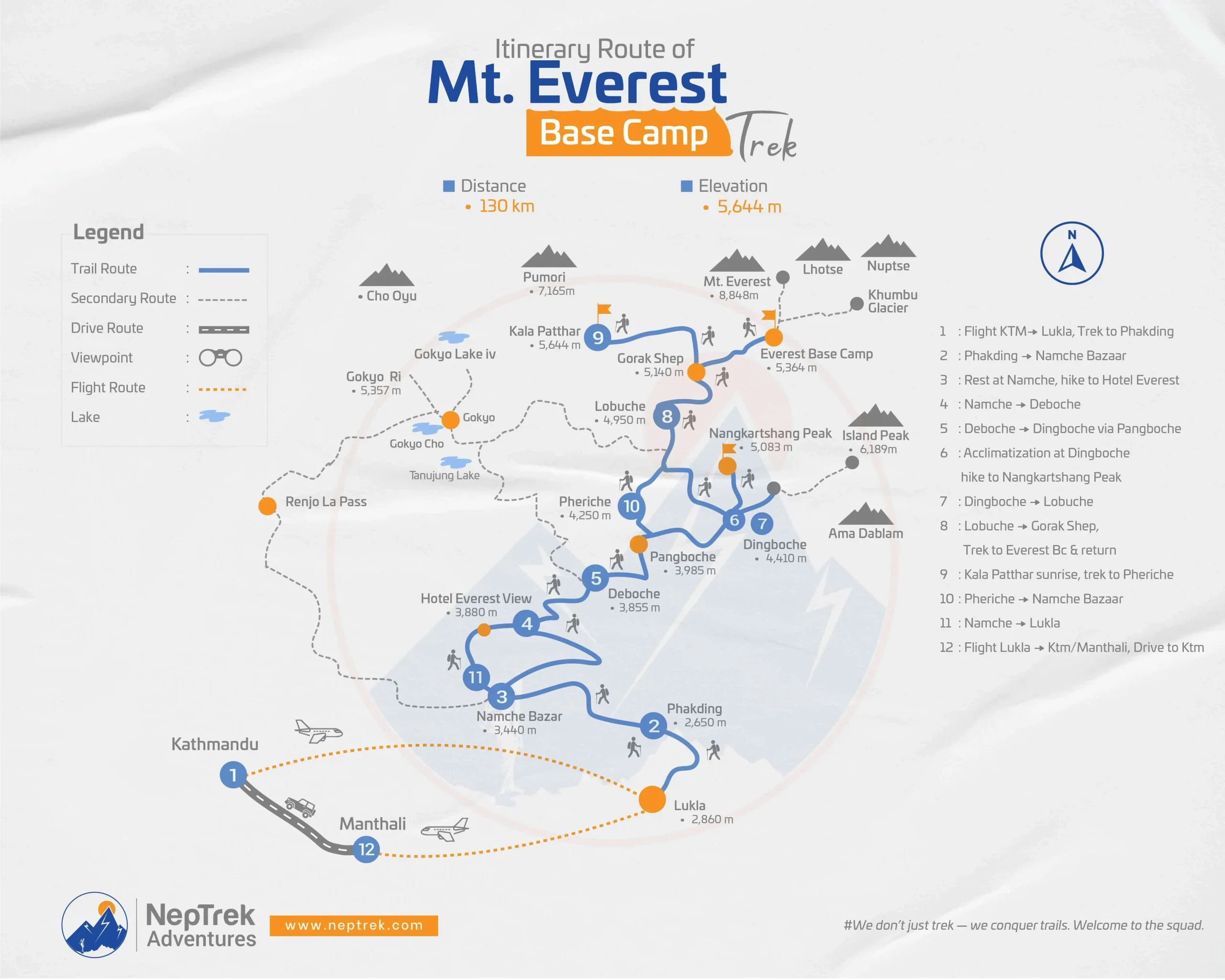
Everest Base Camp Trek Elevation Profile
|
Lukla |
2,860 meters |
|
Namche Bazaar |
3,440 meters |
|
Tengboche |
3,860 meters |
|
Dingboche |
4,410 meters |
|
Lobuche |
4,950 meters |
|
Everest Base Camp |
5,345 meters |
|
Kala Patthar |
5,645 meters |
Best time to trek to Everest Base Camp
Don’t know when to plan the Everest Base Camp Trek? Well, if you’re looking for the best time in a year to trek here, Spring and Autumn are absolute times. Stable weather, clear skies, and unobstructed viewing of mountains are characteristics of Spring and Autumn.
Here’s a small breakdown of Spring and Autumn months.
Spring (March-May)
- Stable weather with rain-free days
- Clear skies are best for mountain viewing.
- Rhododendron blossom
- Snowfall at higher elevations in early Spring
Autumn (Late September-November)
- Crisp and dry air
- 100% visibility during the later Autumn
- Snow-filled mountains and picturesque sights
- Amazing weather conditions for trekking
Typical trek day
Each trek day is almost identical to make you habituated with the itinerary.
Here’s how you’ll spend each trek day.
The trek guide wakes you up at 6:30 am with breakfast at 7:30 am. The trek starts immediately after breakfast, at 8 am. The trek continues for 3-4 hours and stops for lunch. Lunch stops are usually an hour long.
Post lunch, you’ll trek for a few hours to the destination and settle in at the tea house.
Dinner orders are at 5 pm, with serving at 7 pm. Post dinner is a trek briefing session with the entire team.
You’ll sleep between 8 and 8:30 pm in a twin-sharing room.
Trek Difficulty
Everest Base Camp Trek isn’t demanding but is moderately challenging. Said this, you must have a sound physical fitness to endure high-elevation thin air, long walking days, and the strain of walking over rugged terrain for multiple days.
Most sections on this trek are easy. However, a few sections along the trek are tiring and often cause altitude sickness.
- Larcha Dovan-Namche Bazaar ascend (tiring)
- Pungi Thanka-Tengboche ascend (tiring and can cause altitude sickness)
- Thugla to Thugla Pass ascend (very tiring and high chance of causing altitude sickness)
- Walk from Gorak Shep to Everest Base Camp (very tiring and causes altitude sickness)
- Gorak Shep to Kala Patthar ascend (extremely tiring)
Apart from these, the trek isn’t demanding. Even novice trekkers with proper physical fitness can embark on and complete this trek safely.
Who can Join?
Anyone with proper physical fitness can embark on the Everest Base Camp Trek. This once-in-a-lifetime experience is for everyone, from novice to experienced hikers. Here’s a list of who can join this trek:
- Novice trekkers with proper physical fitness
- Seasoned trekkers with some high-altitude trek experience
- Solo trekkers (novice/experienced)
- Couple on honeymoon
- Family and private groups
Said this, we don’t recommend this trek if you’re:
- Below 10 years and above 65 years old
- Pregnant or a mother with a toddler
- Person with existing health issues
- History of altitude sickness
- Physically unfit
It’s an amazing adventure to embark on. However, unless you’re physically and mentally fit, this trek can be risky to embark on.
Gears to Bring
The Everest Base Camp Trek requires serious backpacking. The trek gears and clothes you bring on this trek must be of top quality, whether it’s windproof jackets, sleeping bags, or down jackets.
The gears and clothing must be suitable for the time of year you’re planning this trek. For example, early Spring and late Autumns are cold, whereas later Spring and early Autumns are warm. Thus, you must pack trek gears and clothing properly.
You must bring warm base layers, wind and waterproof soft shells, outer layers, jackets, decent trekking boots, a backpack, personal hygiene items, etc.
Instead of making this section lengthy, we recommend that you visit our Packing list for Everest Base Camp Trek blog for an in-depth backpacking idea.
How to prepare for Everest Trek
Once you complete the backpacking, half of the trek preparation gets completed. However, the most important part of the trek is physical fitness and preparing yourself for the trek.
Here’s what we recommend you train to build physical fitness for the Everest Trek.
- Cardio exercises (hiking, cycling, stair climbing in the gym)
- Endurance and strength buildup training (legs and core)
- Practice hikes with a backpack
- Break in your boots
You should train for at least 2 months before joining the trek.
Apart from physical fitness, you must be mentally sound, too. The trekking demands endurance and strength, and tests you at times. The mountains test your patience and perseverance at times, and you must be ready to accept these throughout the trek.
Everest Base Camp Trek Cost
Our recent changes have the base price for the Everest Base Camp Trek at USD 1699. This price is for individual (solo) trekkers. However, for different group sizes and services included, the trek cost varies.
For big groups, we have some amazing group discounts. Moreover, we let you customize the itinerary, inclusions, and other trek elements at the best price.
One thing you can rest assured about NepTrek Adventures is that our trek prices are quoted without any hidden fees. All the information will be provided to you before booking the trek. Moreover, our treks are 100% safety-driven, led by experienced trek guides, ethical porter support, and handcrafted services.
Extend your adventure
There are amazing adventures in the Everest region to embark on after conquering Everest Base Camp. Returning from base camp, you can trek to Gokyo Lakes via Cho La Pass and Namche via Renjo La Pass and Thame. Or, if you’d like to relax after the trek, a luxury stay in Sarangkot or a Chitwan Jungle Safari could be an exciting multi-day tour.
Let us know about extending the itinerary before booking the trek so that we can quote you an exciting price.
Team NepTrek Adventures
Our team has guided amazing adventurers, maintaining utmost safety and 100% trek completion record. And, we’re proud of this.
NepTrek Adventures is a collective of amazing high-altitude trekking guides, friendly support guides, and representatives who strive to make your adventure one of a kind.
From your initial inquiry to seamless trek bookings, our admin team will assist you 24/7. Our guides are first-aid responders, ensuring your utmost safety throughout the trek. Moreover, they’re excellent communicators with fluent English, feeding you the most interesting Himalayan tales throughout the journey. Our support guides and porters assist you with your backpack during the trek, ensuring that you trek light and comfortably.
Tipping to the crew
Tipping the trek guides and porters at the end of the trek is a common practice in Nepal. It’s a way of showing gratitude to them for their extraordinary services throughout the trek.
Tipping can be collective in a group or individual. Here, the amount for the tip isn’t fixed, and it’s a personal choice. Your tip depends on how well you were served throughout the trek.