












Arrivals and Airport Pickups
At NepTrek Adventures, we strive to make your arrival in Kathmandu hassle-free. Hence, upon your arrival, we’ll provide a complimentary airport pickup. To welcome you, we’ll have our representative at the arrival section with a NepTrek nameplate.
After welcoming you, our representative will transfer you to the hotel in a private vehicle. Here, you’ll meet with a trek guide/manager from NepTrek. Our manager briefs you about the trek.
Note: We strongly recommend that you travel at least 2 days before the trek’s starting date. Since this trek starts from Pokhara, you’ll have to travel from Kathmandu to Pokhara a day before the trek.
Where you’ll stay
The trek cost includes your one-night accommodation in Pokhara and 10 nights at the tea houses along the trek.
We’ll provide you with a three-star hotel with breakfast at Lakeside, Pokhara, for a night. The hotel room we provide will be a twin room. However, if you prefer a private single room, it’ll be subject to some add-ons.
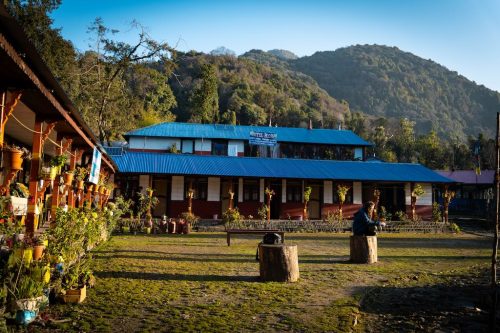
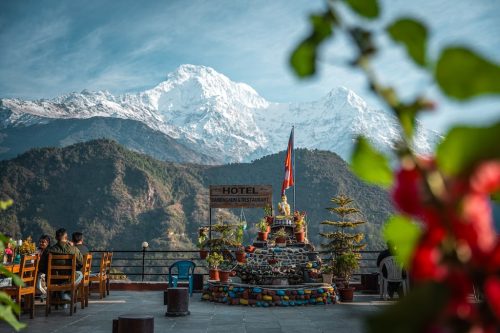
Your accommodations along the trek will be at the tea houses. The tea houses provide twin-sharing rooms that are warm and hygienic. The availability of attached bathrooms is limited, as only a few tea houses have this service. Thus, we’ll provide rooms with attached bathrooms upon availability.
Meals on the go
We provide 11 breakfasts, 11 lunches, and 10 dinners during this trek.
The tea houses provide a meal menu for every meal. Thus, you can order any meals you want from the menu for each main course. Moreover, you can choose one hot drink at each meal, which is included in the trek cost.
We’d love to provide you with meals during your stay in Kathmandu and Pokhara. However, in these cities, you’ll have a handful of choices to visit cafes and restaurants to eat your favourite meal. Thus, the meals on Kathmandu and Pokhara stay aren’t included in the trek cost(Pokhara stay comes with breakfast).
Transportation
Here’s a list of transportation services included in the trek cost.
- Airport pickup upon arrival in Kathmandu
- Pokhara to Sidhing on a jeep (private/sharing- depends on the group size)
- Ghandruk to Pokhara (private/sharing, depends on the group size)
As the trek starts from Pokhara, all our clients are required to travel to Pokhara a day before the trek’s departure. You’ll have the option to take a flight from Kathmandu to Pokhara or a tourist bus ride. Any means of transport you prefer, we’d be more than happy to assist you in booking these tickets with add-ons. However, the trek cost doesn’t cover transportation from Kathmandu to Pokhara and vice versa, unless specified.
Trek porters and luggage weight limit
We care about your convenience during the trek. Thus, to make your trek less demanding, we provide trek porter(s) to carry your backpacks. You’re eligible to assign an 8-9-kilogram backpack to your porter. We’ll provide waterproof duffel bags, where you can pack the gear and clothing for the trek.
Note: We assign a trek porter for a group of at least two or more trekkers, unless specified. For individual trekkers, we don’t provide porters. However, on add-ons, individual trekkers can hire a trek porter.
Travel Essentials
Visas
All travellers, except Indian and SAARC nationals, are required to obtain a Nepal Travel Visa. The Immigration Department at Kathmandu airport’s arrivals issues on-arrival visas. However, a few nationals must apply for a Nepal Travel visa before traveling to Nepal.
The process to get on-arrival visas is straightforward. You must fill on-arrival visa form and pay the visa fee.
Note: The trek cost doesn’t include a Nepal travel visa.
Travel Insurance
All our clients are required to purchase travel insurance before traveling to Nepal. Since the Mardi Himal Trek with Annapurna Base Camp is a high-altitude adventure, trekkers should purchase travel insurance including emergency helicopter evacuation. The highest elevation on this trek is 4,130 meters at Annapurna Base Camp. Thus, your travel insurance must include the helicopter rescue coverage up-to 4,200 meters elevation.
Travel insurance is a must, and you must provide us with proof of your insurance policy before departing for the trek.
Currency Exchange
You must exchange USD/EURO or any currency for Nepali rupees to pay your expenses in Nepal. All the exchange counters in Nepal are authorized for currency exchange. Moreover, the exchange will be as per the rate on the given day. You can exchange the money in Kathmandu or in Pokhara.
Personal Expenses
If you wish to consume services other than “Cost Includes”, you must pay as personal expenses. Your personal expenses include hot showers, hot drinking water, bottled water, soft drinks, WiFi, electricity recharge, additional meals, and so forth.
Trek Permits
You’ll need the Annapurna Conservation Area Project Permit for the Mardi Himal and Annapurna Base Camp Trek. Although it’s a combined trek, you can complete both treks with just one permit.
The trek cost includes the ACAP Permit. Hence, after you pay for the trip, we’ll buy this permit for you. However, for solo trekkers, obtaining this permit requires a visit to the permit-issuing office in Pokhara or Kathmandu.
For an in-depth guide and information related to the permit, read our Annapurna Trek Permit Blog.
Mardi Himal and Annapurna Base Camp Trek Elevation
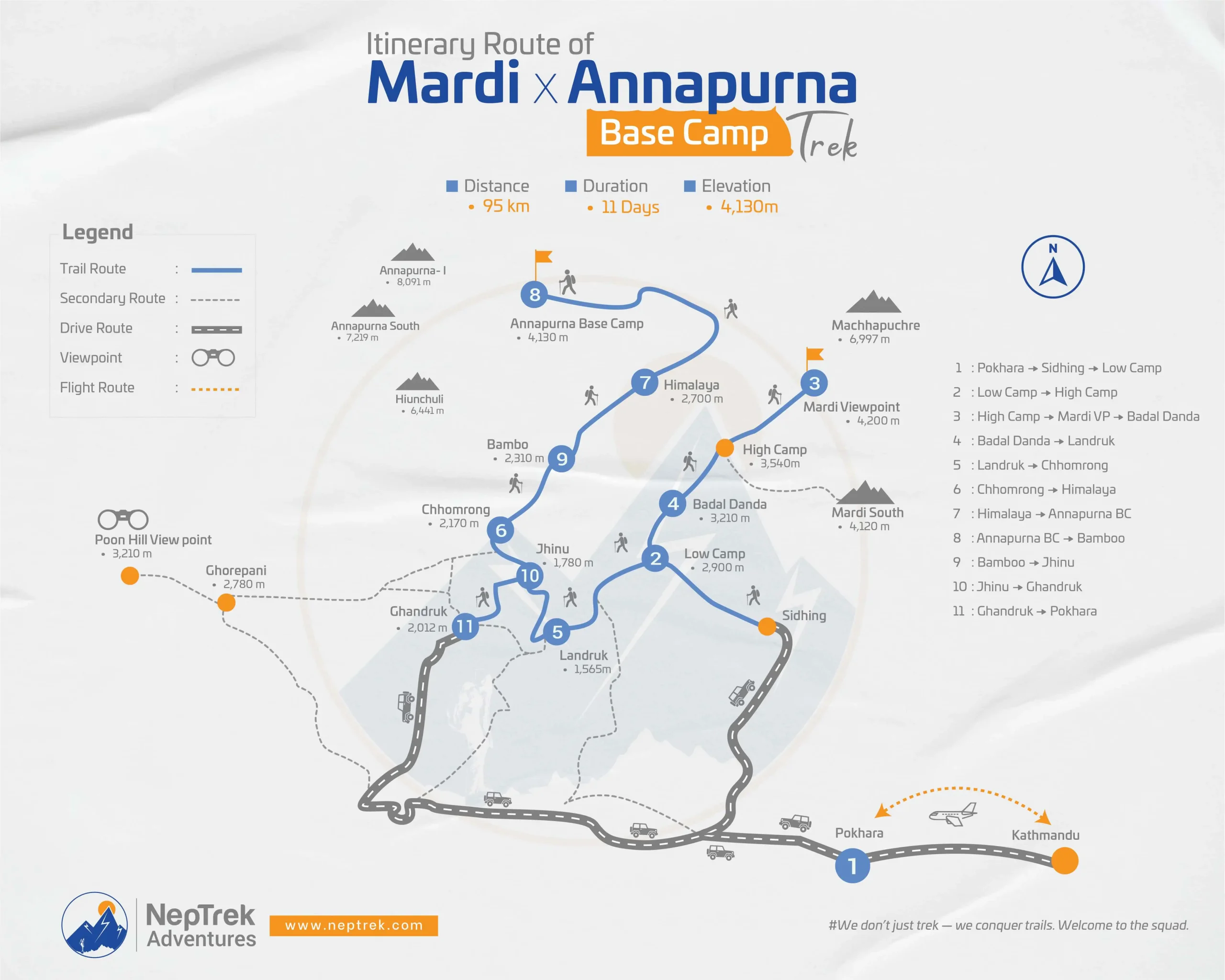
The highest elevation you’ll step in on the Mardi and Annapurna Base Camp Trek is 4,130 at Annapurna Base Camp. On the Mardi side, the View Point sits between 4,000 and 4,200 meters in elevation.
The trek starts from Pokhara, which is situated at an elevation of 822 meters.
Here’s a table to give you an idea of the elevation along this 11-day trek.
|
Landmark |
Elevation |
|
Pokhara |
822 meters |
|
Sidhing |
1,700 meters |
|
Low Camp |
2,900 meters |
|
Badal Danda |
3,210 meters |
|
Mardi High Camp |
3,540 meters |
|
View Point |
4,200 meters |
|
Landruk |
1,565 meters |
|
Chhomrong |
2,170 meters |
|
Himalaya |
3,200 meters |
|
Machhapuchhre Base Camp |
3,700 meters |
|
Annapurna Base Camp |
4,130 meters |
|
Bamboo |
2,310 meters |
|
Jhinu |
1,780 meters |
|
Ghandruk |
2,012 meters |
Best Time for Mardi and Annapurna Base Camp Trek
If you want to trek to Mardi Himal and Annapurna Base Camp, Spring and Autumn are the best times of the year. These are the amazing times of the year with picturesque mountain views, clear skies, and stable weather conditions.
Early Spring and late Autumn are colder with average daytime temperatures of 2-5˚C at the base camp and higher elevations. However, the later Spring and early Autumn are warmer with average daytime temperatures of 8-10˚C.
Other than Spring and Autumn, the winter months are also good times for this trek. With snowfall now occurring earlier in the spring, the winter months are typically dry and cold. Hence, with no snowfall, this trek is doable in January and February, provided you have warmer clothes and trekking gear.
If you’re trekking for mountain views, Summer isn’t the recommended time. However, the lush forest, green high-altitude landscape, warm temperatures, and occasional clear skies make the summer trek amazing.
A day on the trail
Every day on the trail for 11 days looks pretty much the same, itinerary-wise. You’ll wake up between 6:30 and 7 am. The breakfast will be between 7:30 and 8 am.
After breakfast, the trek starts. You’ll trek for 4 hours on average and stop for lunch. Lunchtime will be an hour long.
After lunch, you’ll trek for 3-4 hours to the stopping destination.
The dinner will be between 6:30 and 7:30 pm. After dinner, you’ll have a trek briefing session for 30 minutes.
You’ll go to sleep at 8 pm.
Trek Difficulty
11 days Mardi Himal Trek with the Annapurna Base Camp Trek is moderately difficult. What this means is that most regions on this combined adventure are comfortable and straightforward, with some parts being demanding.
The highest elevation on this trek is 4,130 meters, which isn’t an extreme elevation. Hence, with proper physical fitness, this trek is an absolute adventure for all adventurers, be it novice or seasoned.
Every day on the trail is a new challenge and reward, proving a unique Himalayan experience.
Who Can Join?
Embarking on an adventure is the best possible experience. Said this, not everyone should trek, and there’s a reason.
Is the Mardi and Annapurna Base Camp Trek right for you? Well, we can’t just say it’s for you. It depends on various factors in determining if this trek is ideal for you.
At NepTrek Adventures, we believe that trekking is for everyone, but not for:
- Pregnant women after the first trimester
- Senior citizens with health issues (Chronic)
- People with hypertension, blood pressure, heart, and lung issues
- Kids below 8 years of age
We have a detailed blog on why trekking isn’t for everyone. It’d be amazing if you read through the blog before embarking on this trek.
Trek Gears to Bring
Annapurna Base Camp Trek with Mardi Himal is an 11-day trek. Hence, the trek demands adequate quality gear and clothing.
Backpacking differs slightly regarding what to bring for the trek, which depends on the time of year you’re trekking. Said this, most of the backpack items remain the same throughout the year, no matter when you trek.
You’ll need warm clothes for the head and upper body with soft layers, thermals, and a down jacket. For the lower body, you’ll need warm trekking pants, layers, socks, and trek boots. Moreover, you need to bring travel documents, an insurance policy, snacks, gadgets, etc.
The good part of trekking with us, in a group of at least two or more trekkers, we provide trek porters. They’ll assist you in carrying the heavy backpacks, leaving you to carry the most essentials in a day pack.
For an in-depth guide on trek gears and clothing for this trek, we recommend you read our Annapurna Base Camp Trek Packing List blog. It has almost everything you need to know about the gears, clothes, and other essentials required for the trek.
How to prepare for the Annapurna and Mardi Himal Trek?
Trip bookings and backpacking are an amazing way to start preparing for the Annapurna and Mardi Himal Trek. However, the core trek preparations are the exercises to maintain physical fitness and mental readiness.
Physical fitness is an essential requirement for the adventure. Having adequate physical fitness provides a comfortable trek experience. However, with less or no physical fitness, trekkers strain their body parts extensively and expose themselves to the risk of altitude sickness and severe fatigue.
For physical fitness exercises, here are our top picks:
- Treadmill or stair-master workout for an hour a day
- Outdoor walk, hikes, running.
- Cycling, swimming, yoga, and meditations
You must be mentally prepared for the trek. You’ll get tired, sunburnt, cold nights, chilly winds, humid days, etc. Moreover, you’ll be away from your comfort zone for 11 days. Thus, to enjoy every step of this adventure, you must be well prepared. Accept that you’re in the mountains where resources are pretty much limited, and you won’t have the comforts like you used to. Accepting this makes the adventure less overwhelming.
Mardi Himal and Annapurna Base Camp Trek Cost
The standard cost of the Mardi Himal and Annapurna Base Camp Trek is USD 999 for a solo/individual trekker. However, we do have amazing group discounts for those who’re planning this amazing adventure with family and friends.
The trek cost changes should you prefer customization on various scopes, from itinerary to ‘cost includes and excludes’. However, we encourage you to inform us about the upgrade or customizing the existing offering. Doing so, we’ll provide you with the most reasonable trek price.
Extend your adventure?
After your 11-day trek, you may want to relax and recharge. A humid Chitwan Jungle Safari Tour makes an ideal choice for post-trek relaxation.
Further, if you prefer to explore the cultural richness of ancient Nepal and history, you can tour the heritage sites in the Kathmandu Valley for a day or two. Moreover, to relax in the traditional Nepali hamlets, overnight at Bandipur can be a great choice.
Contact us now to extend your adventure. We’re ready to craft an amazing experience just for you.
Our Team
If there’s one word that describes our team, it’d be ‘AMAZING’. All our clients speak proudly of our hardworking, caring, and professional team.
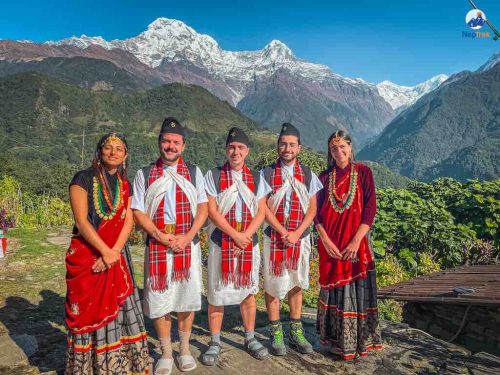
We’re a team of experienced adventurers with years of trekking and guiding experience, all over Nepal. Our fantastic team boasts first aid responder certification, safety-driven trips, excellent communication, and years of guiding experience.
On your Mardi Himal and Annapurna Base Camp trek, an experienced trek guide and a friendly trek assistant (porter) will assist you. They’ll help you in creating an amazing trek experience in Annapurna.
Tipping to the Crew
Tipping the trek guide and porter is a meaningful way to express gratitude and acknowledge their effort in making your trip successful.
Trekkers usually tip their guide and porter at the end of the trek in Pokhara. Be it in a group or individually, both are perfectly fine. The amount isn’t fixed as it depends on how satisfied you are with the effort and services the guides and porters made throughout the trek.