


Airport Pickup & Kickoff
Your Everest and Gokyo adventure begins long before you arrive in Kathmandu. There’s a high chance that you’ll fly past Mt. Everest and other amazing mountains in the Himalayas.
Our representative will be at the Kathmandu airport to greet and welcome you. The following is a private vehicle transfer from the airport to the hotel where you’ll be staying in the city. This airport-to-hotel transfer is complimentary, ensuring a seamless arrival in Kathmandu.
At the hotel’s lobby, you may meet our trek manager and trek guide for a trek briefing. The trek briefing session provides you with the information on the itinerary, trek safety and guidelines, gear check, and any last-minute plan changes. We typically conduct a trek briefing to prepare you well in advance of the trek.
If you arrive a few days early for the trek, you can explore around the Heritage Sites in Kathmandu. This helps you understand the rich cultural heritage in the city. Plus, this tour would be an absolute opportunity to get to know Nepali people and adapt to the Nepalese environment. Furthermore, you can take a tour around trekking shops in Thamel if you want to buy or rent trekking gear before flying to Lukla.
Where you’ll stay?
Everest Base Camp Trek with Gokyo Lakes via Cho La Pass package includes one night accommodation at a boutique hotel in Kathmandu. This accommodation in Kathmandu comes with a buffet breakfast.
On the trek, you’ll stay at the mountain lodges and tea houses. Tea houses and lodges at lower elevations are more sophisticated than those at higher elevations.
You’ll stay in a twin bedroom with attached bathrooms at lower elevations. However, the tea houses at higher elevations don’t have attached bathrooms. At higher elevations, you need to use the shared bathrooms, which are usually neat and sanitized after every use.
At places like Lukla, Namche, and Dingboche, you’ll have the option for heated beds and blankets. However, these additional services aren’t included in the trek cost and are subject to availability and add-ons.
Transportation
Everest Base Camp and Gokyo Lakes Trek via Cho La Pass package includes the following transportation:
- Airport pickup on arrivals
- Kathmandu to Manthali jeep drive (private/group sharing)
- Flights to Lukla (Kathmandu/Manthali)
- Manthali to Kathmandu jeep drive (private/group sharing)
These transports are included in the trek cost. However, the trek cost doesn’t include:
- Any helicopter flights
- Any private jeep transfer (unless specified)
Oftentimes, the flight delays to Lukla force trekkers to fly in a helicopter to Lukla. In this situation, you’re eligible for a refund of the flight ticket price. The reimbursement amount equals the ticket price mentioned.
During the peak trekking season, all flights to Lukla fly from Manthali airport. Thus, depending on when you plan to trek, the flight can be from Kathmandu or Manthali airport. In either case, the trek cost remains the same.
Flight and Porter Luggage Weight Limit
Flights to Lukla allow 15 kg backpack for each person flying. And, for additional weights, the airline charges a certain fee. Also, each trekker can assign 10-12 kilograms of backpack to the porters. Here too, for any additional weight over 12 kg, there is a subject to add-ons or hiring an additional porter.
To make your trek comfortable, we provide a trek porter in groups. Each trek porter carries a 20-25-kilogram backpack, shared between two trekkers. For the main backpack, we’ll provide you with a waterproof duffel bag.
For you, we recommend bringing a daypack of 30-40 litres to carry essential items on the trek. Essential items can be travel documents, snacks, soft shells, a down jacket, a water bottle, etc.
Travel Essentials
Visa
As a trekker in Nepal, you’ll need a tourist visa. Most foreign nationals obtain an on-arrival visa at Kathmandu Airport. The duration of tourist visa in Nepal is 15, 30, and 90 days, with different visa fees for each duration. To obtain a Nepali tourist visa, you’ll need a valid passport and a visa fee in USD.
Once the visa is issued, you can travel in Nepal for the specified time period. However, having a Nepali visa doesn’t mean that you can travel anywhere in the country.
Travel Insurance
Everest Gokyo Lake Trek is an extreme elevation adventure. Hence, embarking on this trek poses a significant risk of altitude sickness and injuries. Hence, you must purchase comprehensive travel insurance up to 6,000 meters with emergency helicopter evacuation and medical coverage. While trekking with our experienced team of guides and support staff, the occurrence of such incidents is near zero. However, you’re required to have proper coverage during emergencies for peace of mind throughout the trek.
You’re required to provide us with a digital copy of your travel insurance policy so that we can use it to coordinate a helicopter rescue in case of natural and health emergencies.
Currency Exchange & Personal Expenses
To pay for your personal expenses on the, we suggest you to exchange USD to Nepali rupees. All the tea houses accept Nepali rupees instead of USD. At some tea houses, you can pay with your debit/credit cards. However, each transactions subjects to a service fee, which costs you a bit more.
We suggest that you exchange or withdraw money in Kathmandu. There are a few ATMs and cash exchanges in Lukla and Namche. However, the exchange rates they provide are a lot lower than in Kathmandu.
Everest Gokyo Lakes Trek Permit
Everest Base Camp Cho-La Pass Gokyo Lakes Trek requires two trek permits. These permits are available for individual (solo) and group trekkers.
Specifically, you will need the Khumbu Pasang Rural Municipality Permit and the Sagarmatha National Park Permit for the Everest Gokyo Lakes Trek. Both permits can conveniently be obtained at the checkposts in Lukla and Monjo.
The trek package includes these permits. Hence, you don’t need to pay an extra amount for the permits. Your trek guide purchases these permits at one of the checkposts and carries them throughout the trek.
To find additional details about Everest Trek Permits, we highly recommend reading our blog for further information.
Elevation
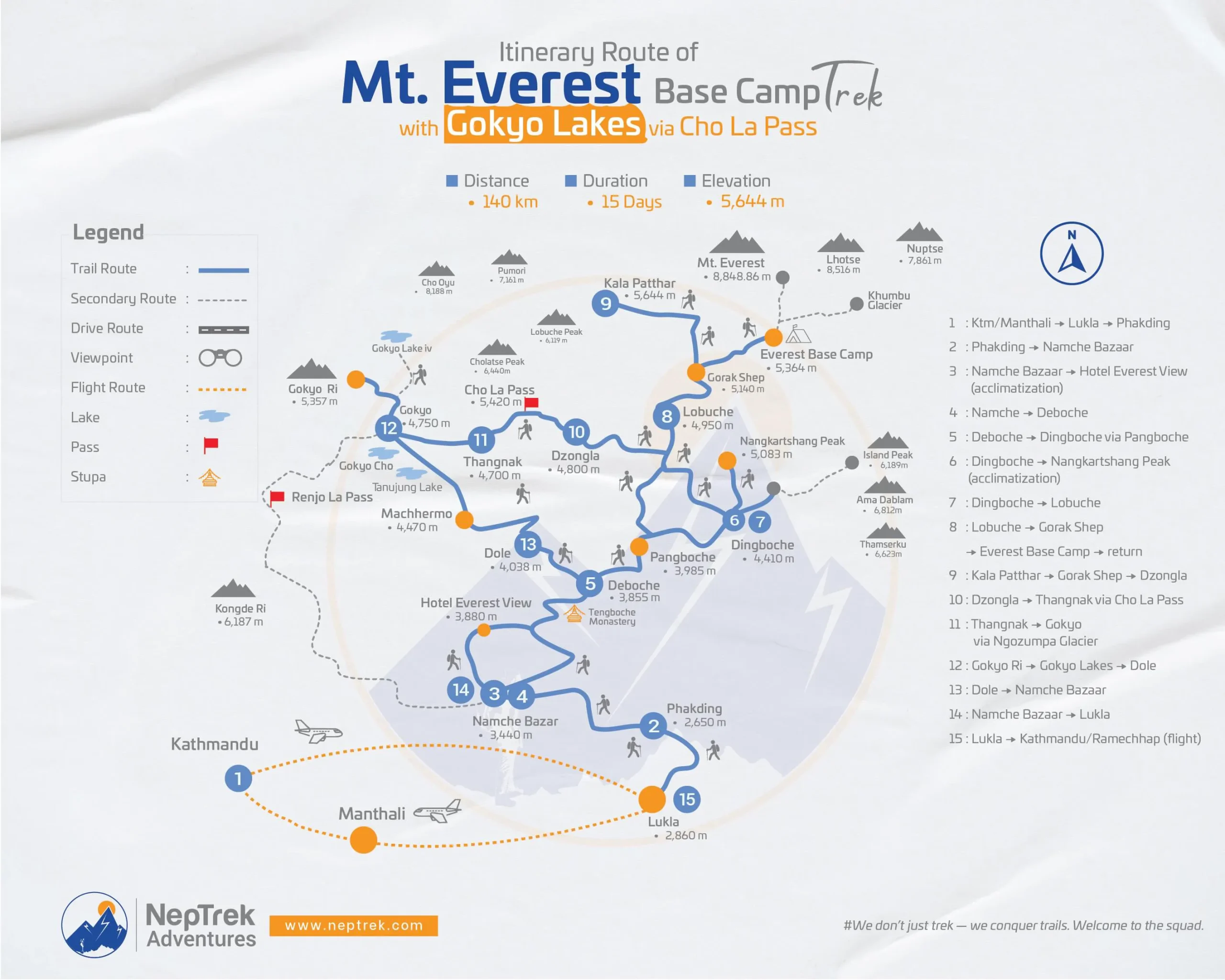
Everest Base Camp and Gokyo Lakes Trek via Cho La Pass begins at Lukla, at 2,860 meters. The highest point on this trek is Kala Patthar at 5,646 meters and Cho La Pass at 5,420 meters. Everest Base Camp sits at 5,345 meters, whereas Gokyo Ri sits at 5,357 meters.
Here’s an elevation profile of the popular landmarks of the Everest Gokyo Lakes Trek.
|
Lukla |
2,860 meters |
|
Namche |
3,440 meters |
|
Tengboche |
3,860 meters |
|
Dingboche |
4,410 meters |
|
Lobuche |
4,950 meters |
|
Everest Base Camp |
5,345 meters |
|
Kala Patthar |
5,646 meters |
|
Cho La Pass |
5,420 meters |
|
Gokyo Lakes |
4,750 meters |
|
Gokyo Ri |
5,357 meters |
Best time for Everest Gokyo Lake Trek
If you want to see all the mountains in the Everest region with utmost visibility and stable weather, Spring and Autumn months are the best time of year. Precisely to be the best months, April and November are the two absolute months in a year for dreamy weather and unobstructed mountain views.
Winter months are also a great time to trek to Everest and Gokyo Lakes. However, it gets extremely cold at higher elevations, with heavy snowfall.
Weather and Temperature
Usually, mornings and evenings at lower elevations are chillier than at higher elevations. During the day, especially on sunny days, it gets warm at lower and higher elevations.
The summer months are warmer than the rest of the year. Later Spring and early Autumns are warmer. However, early Spring and later Autumn are colder, with ending/approaching winter.The weather remains stable during the spring and Autumn months. However, in the summer months, it rains heavily, even at the higher elevations. And, in winter, it gets extremely cold with snowfall.
We have amazing Everest region travel guides for you, where we’ve put different blogs on the Everest region regarding the weather and temperature throughout the year. Check it out to plan your Everest Gokyo Lakes trek smartly.
Physical Fitness
Everest Base Camp and Gokyo Lakes Trek via Cho La Pass is moderate, with a few demanding sections. Precisely, the lower elevations are easy to moderate. However, the trek sections over 5,000 meters are demanding at times, as hiking to Kala Patthar, Gokyo Ri, and even trekking to Everest Base Camp.
Hence, embarking on this 15-day-long adventure requires significant physical fitness and mental preparedness. The elevation of Everest tests you at times and also rewards you with a once-in-a-lifetime experience.
To build physical fitness, you must work on cardio exercises and also on building leg strength.
We have an in-depth section on Physical Fitness in the FAQs section. We hope you’ll scroll down to the section.
Altitude Sickness and Acclimatization
Trekkers who plan the Everest Gokyo Lakes Trek often worry about altitude sickness, and it’s obvious because of the extreme elevation. However, with adequate acclimatization, trek preparation, physical fitness, and trekking with an experienced trek guide, the risk of getting altitude sickness on the trek. Not boasting, but all of our clients have completed their Everest region trek without getting altitude sickness.
Our 15-day Everest Gokyo Lakes Trek has two acclimatization stops at strategic landmarks. Moreover, our experienced guide and support staff ensure that you’re safe and comfortable throughout the trek. And if needed, we’ll customize the itinerary with additional acclimatization on the trek.
Rehydration and adequate rest prevent altitude sickness. Moreover, to avoid altitude sickness, we suggest you take Acetazolamide (Diamox) with consultation with a physician.
Packing List: What to Bring?
The trekking gear and clothes you bring for the trek determine the comfort during the trek. Thus, proper backpacking with appropriate trek gear and clothes is a must for this trek.
Instead of bringing thick winter clothes, it’s wise to wear multiple thin layers, with a thermal base layer, an intermediate warm layer, and an outer shell or down jacket. Similarly, a thermal layer with trekking pants keeps your legs warm against cold temperatures at higher elevations.
The higher elevations of the Everest region are rugged with glaciers and icy patches. Hence, for a comfortable walk, a premium ankle support, a break-in trekking boot with proper grip is a must. And to keep feet warm, moisture-wicking woollen socks are highly recommended.
Besides gears and clothing, you’ll need health and skincare products. Moreover, snacks, gadgets, and extra money for personal expenses are a must.
To guide you through the packing list, we have a complete packing list for the Everest Base Camp Trek. Check it out and learn smart backpacking for the Everest Base Camp, Cho La Pass, and Gokyo Trek.
Who Can Join?
Everest Base Camp Trek with Gokyo Lakes via Cho La Pass is an ideal trek for novice trekkers. And for seasoned trekkers, this trek would be an amazing adventure and a mountain viewing.
Yes, novice trekkers with proper physical fitness can embark on this trek. Despite some demanding sections, most of the route is intermediate and straightforward. There are two acclimatization days, ensuring utmost rest and adaptation to the altitude. Moreover, guided by an experienced trek guide from NepTrek, this trek is highly achievable.
However, this trekking isn’t for everyone. We have certain criteria on who should trek and who shouldn’t.
Read our Why Everyone Shouldn’t Trek Blog for a comprehensive idea of whether to embark on this trek or not.
NepTrek’s Crew: Guides & Porters
We take pride in our amazing trek crews.
Our trek guides are experienced high-altitude guiding professionals with various trainings and certifications. First, all our guides are licensed to lead trekking groups. Thus, on the Everest Gokyo Lakes Trek, you’ll get an experienced licensed trek guide as the leader.
Our guides are wilderness first-aid certified. This makes our guide a true asset at NepTrek, ensuring utmost safety to our clients during the trek. Moreover, they’re trained with high-altitude health monitoring, assessing the altitude sickness symptoms, and more.
Furthermore, our support staff and trek porters are amazing assets. They’re friendly, supportive, and do their best in making your trek one of a kind. They assist you by carrying the heavy backpack throughout the trek.
Itinerary Customization
Every traveller’s needs are different. For many, 15 days might be an ideal duration to complete this trek. However, for some, this trek might not be doable in 15 days. Or, some prefer to fly out from Gokyo or Namche instead of walking back to Lukla and taking a flight to Manthali.
Additional acclimatization might be needed for some trekkers. Or, some might want to chill by the Gokyo Lake shore for an entire day, because why not?
This trek, in particular, is doable in another way. From Gokyo, instead of descending to Dole, you can cross Renjo La Pass to Thame and Namche. Either way, it takes two days to reach Namche. But crossing Renjo La Pass would be an amazing addition of a high mountain pass crossing in a single go.
At NepTrek Adventures, we welcome your trek customization request anytime. However, this must be before you book the trek.
A day on the trail
A regular trek day begins with breakfast at 7-7:30. At 8, the team starts the walk.
You’ll trek for 3-4 hours before stopping for lunch. The lunch will be an hour, depending on how busy the tea houses get.
After lunch, you’ll walk for another 2-3 hours and stop at the day’s destination. You’ll get a twin bedroom with an attached bathroom upon availability.
The dinner order will be at 5-5:30 pm, and dinner will be at 7 pm.
After dinner, you’ll have a trek briefing session for the next day.
During acclimatization day, you’ll begin the acclimatization hike after breakfast. Acclimatization hikes are usually 4-5 hours long.
On the day of crossing high passes, you’ll start trek early to avoid the wind and changing weather. Depending on weather conditions, your trek guide sets the trek’s start time.
Everest Gokyo Lakes Trek Cost
You can find the Everest Base Camp Trek with Gokyo Lakes via Cho La Pass Trek cost in our trip cost section, where we have amazing prices for individuals and groups. We have a “Cost Includes” and “Cost Excludes” section in the Cost Details section that details all the benefits the trek cost provides.
However, the trek cost changes with customization, such as additional acclimatization days, longer itineraries, meal and accommodation preferences, helicopter flights, etc.
Please let us know your preferences for customization, if any, before booking the trek. We’ll be able to provide you with an amazing quote for your preferred trip style.