


Meals and Accommodation
For the seven-day trek, you’ll get 7 x breakfast, 7 x lunch, and 6 x dinner. The tea houses and lodges along the trek serve these meals. You’ll get a welcome/farewell dinner as a complimentary.
Typical breakfast includes Tibetan bread, chapati, vegetable curry, toast (in Syabru, Langtang, and Kyanjin), tsampa porridge (local flour porridge), oat porridge, muesli with yak curd (summer months for yak curd), potatoes, tea, coffee, etc. We suggest you order a set breakfast that comes with multiple items with adequate proportions.
The main meals, lunch, and dinner, come with a handful of choices. It includes a major meal, Dal Bhat with lentil soup and cooked vegetables, a staple Nepali dish. Veg dumplings, fried noodles, spaghetti, sandwiches, fries, chapati, fried rice, and so forth are popular meals for lunch and dinner.
With each main course, you’ll get one hot drink, such as black tea, milk tea, lemon tea, or ginger lemon honey.
Accommodation during the trek
Upon arrival in Kathmandu, you’ll get a complimentary airport-to-hotel transfer on a private vehicle. You’ll get a boutique hotel for a night stay in Kathmandu that you can utilize before or after the trek.
Along the trek are the local people-run tea houses and lodges where you’ll be accommodated. Usually, you’ll be accommodated in twin-sharing rooms. Except for Lama Hotel, you’ll get attached bathrooms at every accommodating tea house along the trek.
Also, at every place except Lamg Hotel, you’ll get electricity to charge your phones, batteries, and gadgets. However, you’ve to pay extra fees up to Rs. 300 per use of each amenity. Hot water showers are available at every tea house and cost Rs. 300-500. Also, you’ll get wifi at most places that cost Rs. 200-300.
Please note that you’ll pay for wifi, hot water shower, and electricity charges. These amenities are exclusive to Langtang Trek cost you pay us while booking the trek.
Transportation
Here’s a list of transportation benefits once you pay Langtang Trek Cost to us.
- Airport pickup and hotel transfer upon arrival
- Hotel to bus stop transfer on a taxi (private vehicle pickup from hotel to Syabru for the large group)
- Two-way bus/EV van/shared jeep ticket (Kathmandu-Syabru and Syabru-Kathmandu)
- For groups of 5-6 people, we’ll provide a private jeep/van.
There are no flights involved on this trek. However, if you decide to return to Kathmandu from Kyanjin Gompa by helicopter, we’ll get the helicopter for you (to be paid for by the client).
Langtang Valley Trek Permit
Langtang National Park entry permit is the only permit you’ll need for Langtang Valley Trek. This entry permit costs Rs. 3000 (USD 25 or around) and is available at the National Park checkpost in Dhunche and the permit office at Nepal Tourism Board, Kathmandu.
For Indian and SAARC Nationals, this permit costs Rs. 1500.
If you’re a solo trekker, it’s mandatory to trek with a licensed guide for Langtang Trek in 2025. Thus, you can’t get the trek permit if planning this trek solo.
However, upon planning this trek with a registered trekking agency like us, we’ll get you this permit. Once you book the trek and pay the confirmation fee, we’ll buy the Langtang National Park entry permit fee, which is included in the trek cost.
Learn more about Langtang Trek Permits in this blog.
Trek safety and security
Trekking to Langtang Valley is safe for all sorts of trekkers. Moreover, you’ll be safe and secure throughout this wholesome adventure, guided by licensed trekking guides and porters.
Whether you’re an individual or in a group, your trek guide accompanies you on constant watch. Further, the trekking porter carries your additional backpack, ensuring the total safety of personal stuff.
Your accommodations and meals will be at the best available tea houses. Thus, you’ll have comfortable overnight accommodation and hygienic meals, providing adequate rest and good food.
During health emergencies and natural calamities, you’ll need a helicopter evacuation. However, for timely helicopter rescue, you must have valid travel insurance with helicopter search and rescue. First aid will be provided by the trek guide (first aid responder certified) on minor injuries along the trek.
Travel Insurance: A must!
Travel insurance is necessary for the Langtang and Kyanjin Trek in 2025. It’s a high-altitude trek, situated remotely, posing potential outdoor risks. Due to this, you may get altitude sickness, get injured, or need immediate medical attention. Hence, for rapid access and safe return to the hospital, you’ll need a helicopter evacuation. And the helicopter evacuations are expensive. Thus, your travel insurance with helicopter search and rescue coverage comes into play.
Travel insurance with helicopter rescue coverage pays for the entire helicopter rescue and gets you a helicopter on time. Moreover, it bears your hospitalization cost, medication bills, and more.
We highly recommend you get travel insurance up to 4,900 meters, the highest altitude you’ll trek in Langtang Trekking. Moreover, we request that you provide proof of your insurance purchase after you book the trek with us.
How difficult is the Langtang Valley Trek?
Based on your fitness and prior high-altitude trek experience, Langtang Trek can be easy, moderate, or demanding. Still, it’s among the easiest and first-to-take treks in Nepal for novice hikers.
If you’re a novice trekker, trekking to Langtang and Kyanjin is best. It can be demanding at times but rewarding. It’s full of wholesome adventure, mountain panorama, and cultural experience.
Moreover, if you have some high-altitude trek experience, the Langtang Trek can be easy. Also, you can plan a 7-day Langtang Trek as a preparation trek if you plan to embark on demanding treks like the Everest Base Camp Trek.
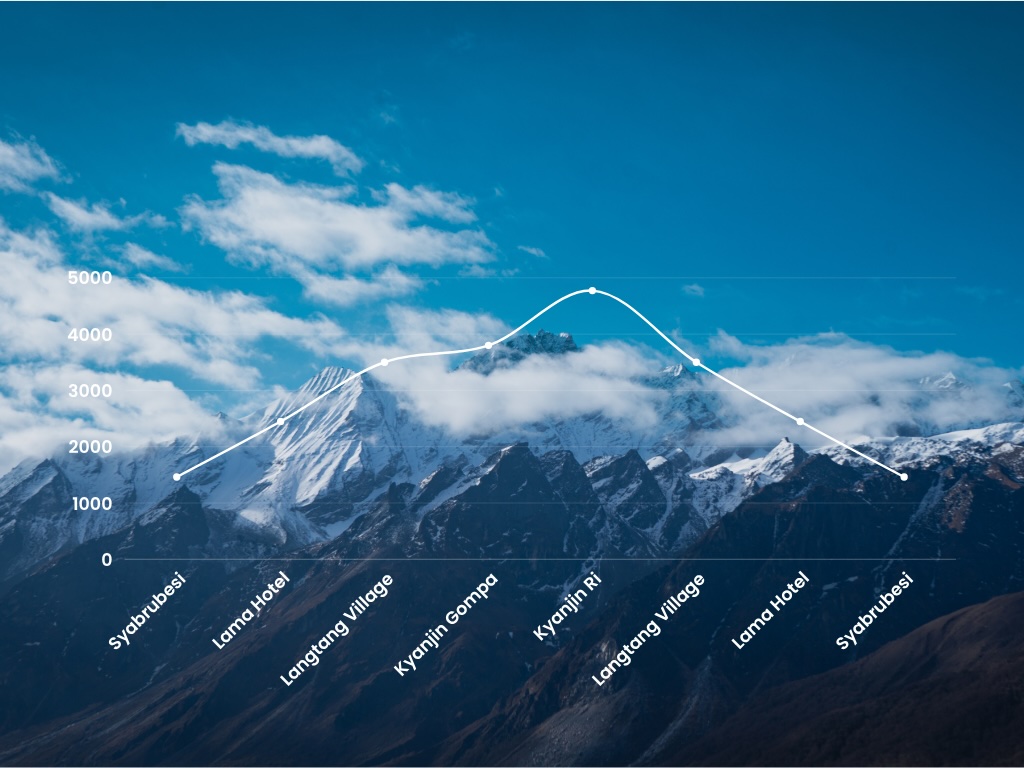
The last human settlement landmark on this trek is Kyanjin Gompa. However, you can hike to Kyanjin Ri and Tsergo Ri, the two beautiful viewpoints. Here, while ascending to the viewpoints, the walk can get tiring and challenging. Worse, you may experience vomiting and nausea, common signs of altitude sickness. However, upon descending to Kyanjin Gompa or Langtang Village, you’ll get comfortable again.
Being a low-altitude, seated, Langtang Valley is easy to trek. Moreover, the entire route length (Syabru Besi-Kyanjin Gompa-Syabaru Besi) is 77 km, which is short and easy, doable in 7 days.

Best time for Langtang Valley Trek
The best time for Langtang Trek is Spring (March-May) and Autumn (September-December).
March, April, and May are three beautiful Spring months, ideal for this trek. Early March blesses you with the wholesome sights of snow-capped mountains. Mid-Spring, throughout April, is perfect for rhododendron blossoms. The rhododendron blossom makes the lower regions like Lama Hotel, Ghoda Tabela, and Langtang Village vibrant. Moreover, the all-day clear favors the ultimate sightseeing from Kyanjin Ri and Tsergo Ri.
May-end to mid-June is the best time to trek Langtang Valley for greenery and a fresh outlook. The occasional rain, misty trails, and snow-filled mountains make these two months the best.
September and October are best for clear weather days. As these are post-rainy months, you’ll see greenery even at Kyanjin Gompa. The rain-washed, fresh, and green landscape leaves you in awe. Also, the temperature in Autumn starts decreasing, making it ideal and favourable for day walks.
If you prefer all-day mountain panorama, clear blue skies, sunrise, sunset, and are an avid landscape photographer, Langtang Trek in November is for you. But November can get cold, but it is the best month for this trek.
July and August are rainy months and not the best for this trek. And from December to February, it becomes cold and snowy, with daytime and nighttime temperatures below freezing. Also, the snowfall in winter makes it challenging to trek to Langtang. Hence, during late Summer and all winter, most tea houses remain closed due to cold, rain, and snow, with almost no trekkers en route.
Trek Etiquette
There are certain things you must be well aware of in Langtang. It not only makes your trek experience better but also makes you a responsible trekker.
Foremost, the majority of the ethnic community in Langtang practices Buddhism. Hence, no matter your religion, while trekking here, you must respect every element of Buddhism. Consuming meat products, campfires, and BBQs is not allowed at some places on the trek. Moreover, you mustn’t harm or destroy any religious sites like prayer wheels, stupas, chhortens, etc.
Second, you’ll trek inside the Langtang National Park area. Thus, you must comply with all the national park policies and guidelines. You can’t carry camera drones (carry with drone permit), loud speakers, knives, or lighters. Moreover, you can’t kill the animal or harm the vegetation in the park.
Further, littering with plastic wrappers and unused personal stuff is strictly prohibited. As we prioritize carbon-zero trekking, we kindly recommend your support of our initiative. If possible, please carry non-plastic water bottles. Also, we suggest you dump plastic wrappers on the bins on the route and at the tea houses.