













Arrivals and Airport Pickup
Your Ghorepani Poon Hill Trek with Ghandruk begins right after you land in Kathmandu airport. You’ll get a personal welcome at the arrivals by our representative/guide. Following the arrivals, you’ll get a private airport-hotel transfer in a taxi. No waiting, no confusion– a seamless arrival and start of your Himalayan adventure.
We usually organize a trek briefing session at the hotel’s lobby in Kathmandu. However, if you need rest and recovery from jet lag, your guide organizes the trek briefing session in Pokhara. You’ll go through the trek itinerary, weather updates, safety protocols, guides and porters’ updates, and final gear check before starting the trek. Also, you can buy/rent trekking gear in Kathmandu or Pokhara before leaving for the trek.
Where You’ll Stay
We believe that a comfortable accommodation significantly improves the entire trek experience. And thus, we choose the best lodges en route that prioritize authenticity and hospitality.
In Pokhara, you’ll get a night of accommodation at a three-star hotel. You’ll get a mountain-facing, air-conditioned, twin room with an attached bathroom.
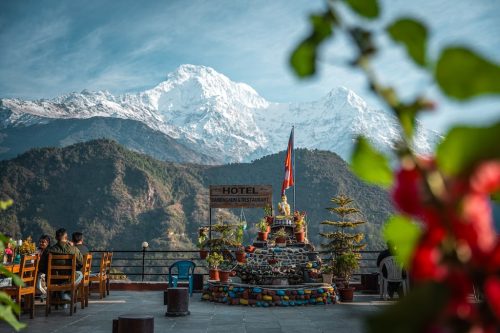
On the trek, you’ll stay at the lodges and tea houses. At most places, except at Tadapani, you’ll get a twin bedroom with an attached bathroom. Every overnight throughout the trek comes with great hospitality and scenery. The Annapurna mountains peek outside your window, and you wake up and go to bed with this view. How surreal it is!
Meals on the Go
Hygienic and nutritious meals are an essential part of any trek. Thus, on your five-day trek to Ghorepani Poon Hill and Ghandruk, you’ll get hygienic plus nutritious meals at every tea house. The tea houses we stay at every place are the best ones in the region. So, they serve quality meals for trekkers, guides, and porters.
In this trek, you’ll get five breakfasts, five lunch, and four dinner. One breakfast will be in Pokhara, and the rest of the meals will be on the trek. On the 5th day, you’ll eat lunch at a restaurant in Lakeside, Pokhara.
You’ll get a meal menu and can have your favourite meal on each main course. However, extra meals are subject to add-ons.
Transportation
Ghorepani Poon Hill Trek cost you pay to us includes all the ground transportation during the trek.
Here’s what is inclusive in the trek cost:
- Airport pickup on arrivals
- Lakeside, Pokhara to Birethanti (Shared/Private Jeep based on group sizes)
- Ghandruk to Lakeside, Pokhara (Shared/Private Jeep based on group sizes)
FYI, this five-day trek starts from Pokhara. It requires trekkers to travel from Kathmandu to Pokhara on their own. You can travel from Kathmandu to Pokhara by an overland tourist bus or flight. The trek doesn’t include your travel between Kathmandu and Pokhara. However, on request and add-ons, we’ll help you organize your travel between these two cities before and after the trek.
Trek Porters and Luggage Weight Limit
We provide a trek porter to carry your heavy backpack throughout the trek. This gives you an amazing opportunity to trek light with a small daypack. On this trek, we assign trek porter(s) based on the group size.
We provide a trek porter for a group of two or more trekkers. A porter carries about an 8-10 kg backpack of one trekker, with a combined weight of no more than 20 kilos.
In this particular trek, the itinerary is short. So, you don’t need to bring loads of clothes and gear. We’ll provide one duffel bag for two trekkers to pack clothes and trek gear, about 15 kilos for the porter.
Again, we request that you not bring many clothes and gear. You’ll trek for only 4 days, where you don’t need a lot of clothes.
Travel Essentials
Travel essentials, including documents, visas, passports, and Nepali currency, are as important as trekking gear and clothes. Here’s what you’ll need to trek to Ghorepani Poon Hill and Ghandruk as an international traveller.
Nepali Tourist Visa
Except for a few countries, most international travellers to Nepal get a visa on arrival at Kathmandu airport. Immigration at Kathmandu airport issues on-arrival visas.
You can get a Nepali tourist visa for 15, 30, and 90 days with respective visa fees. Getting it is straightforward at the kiosk booths.
We don’t provide or issue Nepali tourist visas, and the trek cost doesn’t include the visa fees.
For details, please check the official website of the Department of Immigration, Nepal.
Travel Insurance
Ghorepani Poon Hill Trek with Ghandruk isn’t a risky or demanding adventure. It’s an extremely safe trek with no difficulties whatsoever. However, you’ll still need travel insurance before joining this trek.
Any outdoor adventure might turn into a nightmare without noticing. For example, if you slip on the route, get injured, or fracture bones, you’ll need emergency medical attention. First aid support won’t be sufficient. And at such instances, for immediate expatriation, a helicopter rescue is a must. Hence, to get a helicopter rescue during emergencies, you’ll need a travel insurance policy. Other than emergency rescue, the travel insurance covers a multitude of areas such as loss & damage of personal items, delayed schedules, etc.
We suggest that you provide us with proof of travel insurance before joining the trek. It helps us to coordinate with helicopters and related stakeholders should you experience any emergencies or attention along the trek.
Nepali currency for personal expenses
Personal expenses during the trek are services other than those included in “Cost Includes”. For every use of extra services, you must pay at the tea houses. And to pay for these, you’ll need Nepali rupees, as most tea houses accept Nepali currency. Your credit card and international cards don’t work in the mountains.
If you’re wondering about your personal expenses, they are WiFi, electricity recharge, hot shower, boiled drinking water, bottled water, extra meals and drinks, etc.
We advise you to exchange your currency for Nepali rupees in Kathmandu or in Pokhara.
Trek Permits
You’ll need an Annapurna Conservation Area Project permit for the Ghorepani Poon Hill Trek with an overnight stay in Ghandruk Village. The permit is inclusive in the trek cost, and thus, our team arranges this permit once you book the trek with us.
We may ask you for a digital copy of your passport, a photo, and a few details for the permits. Once the permits are issued, you’ll receive a copy of them. At every checkpoint, your trek guide verifies the permits.
For solo trekkers, this permit is available at the Tourism Board in Kathmandu and Pokhara. For details, please check our ACAP Permit blog.
Trek Elevation
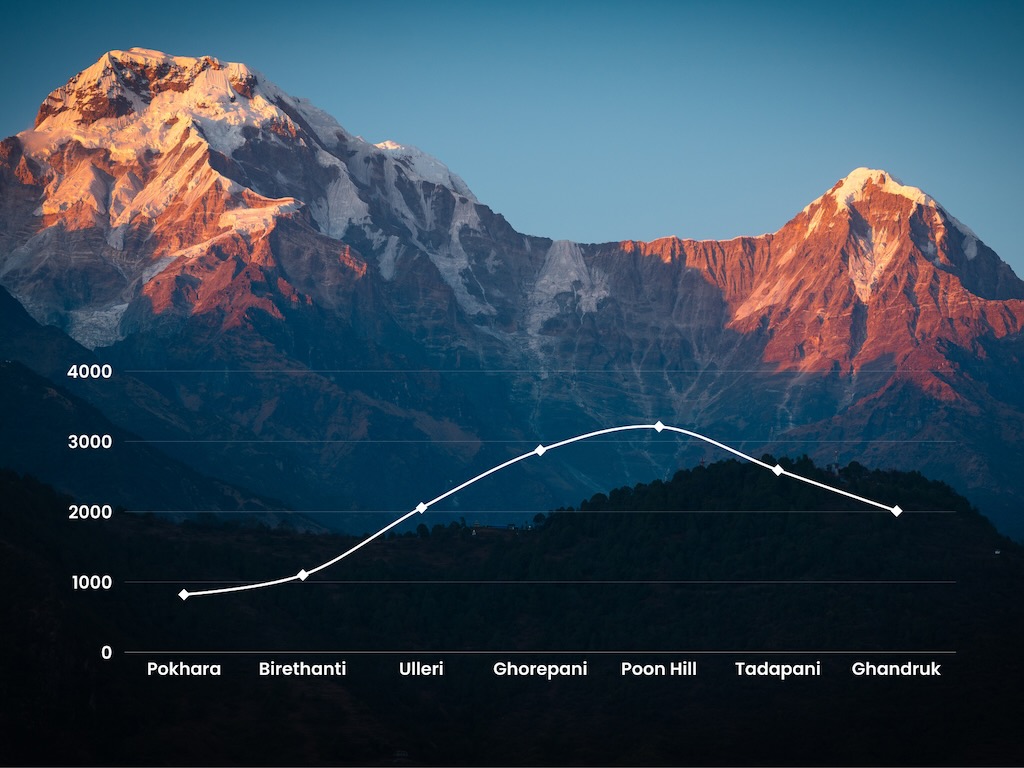
The highest elevation in the 5-day Ghorepani Poon Hill Trek is 3,210 at Poon Hill. The lowest elevation is Pokhara, around 800 meters.
Here’s a guide to the elevations of various landmarks along the trek.
|
Landmark |
Elevation |
|
Pokhara |
822 meters |
|
Tikhedhunga |
1,480 meters |
|
Ulleri |
2,050 meters |
|
Ghorepani |
2,874 meters |
|
Poon Hill |
3,210 meters |
|
Thaple Danda |
3,165 meters |
|
Banthanti |
2,800 meters |
|
Tadapani |
2,630 meters |
|
Ghandruk |
2,012 meters |
Best time to trek to Ghorepani and Poon Hill
Ghorepani and Poon Hill are adorned with vibrant rhododendron blossoms in March and April. And a prominent reason for trekking here is to experience the magical rhododendron blossom and the picturesque Dhaulagiri and Annapurna mountains. Moreover, the weather in March and April remains perfect all day.
If you want to have this magical experience, the best time to trek to Ghorepani Poon Hill and Ghandruk is early to mid-spring.
Another great time to visit Ghorepani and Poon Hill is September-February, all of autumn and winter. Except for the rhododendron blossom, you’ll experience most of the trek, from amazing mountain sights to magical sunrises and sunsets.
Typical Trek Day
Here’s a step-by-step breakdown of what each day on this trek looks like.
- You’ll wake up around 6:30 am, have breakfast by 7:30, and start the trek by 8 am, sharp.
- You will trek for about 3 hours, then stop for lunch at a tea house.
- Lunch break will be 1-1.5 hours long.
- You’ll trek for 2-3 hours after lunch to the destination.
- Dinner will be at 7 pm.
This is what your everyday on the trek looks like for 4 days. Each step listed above is how your guide sets the pacing on a given day. However, depending on the fitness, route distance, and weather conditions, the plan may vary.
To eliminate the last-minute changes, you’ll have a trek briefing session each evening.
Trek Difficulty
Almost all the treks in Annapurna Sanctuary are moderately difficult. However, the Ghorepani Poon Hill Trek with Ghandruk is the easiest among all. The short trek distance, low elevation, well-established trek route, and ample tea houses make it an ideal trek for everyone. Moreover, there are very few steep ascents that are manageable at a steady pace.
For beginners, families with kids, and senior adventurers, this five-day adventure offers a front-row-seat panorama of the Annapurna mountains without breaking a sweat. Anyone with decent physical fitness can comfortably complete this trek.
Who can join?
Ghorepani Poon Hill Trek with an overnight in Ghandruk is an easy trek that most trekkers can join. The low elevation, shorter distance route, ample tea houses, and safe trekking routes make it doable for most.
It is more of a viewpoint than a high-altitude destination trek. Because of this, the trek is accessible for every physically fit traveller. Whether it’s a beginner, a family with kids, a senior, or a landscape photographer, it fits all.
However, we advise the following people to consult with a doctor before embarking on this trek.
- People with existing health issues and chronic illnesses
- Kids below 5 years and seniors above 70 years.
- Pregnant women
We have a detailed guide on Who Should Trek, providing detailed information on what goes into high-altitude trekking in Nepal and what it demands to be an efficient trekker. Also, it covers various topics, highlighting who should and shouldn’t trek.
Trek Gears to bring
Longer treks in Annapurna Sanctuary, like the 10-day Annapurna Base Camp Trek, require a significant amount of gear and clothes. It includes a sleeping bag, trekking poles, down jackets, crampons, and a bigger backpack.
As a trekker in the Ghorepani Poon Hill Trek with Ghandruk visit, you don’t need to carry a ton of trek gear and clothes. In this five-day trek, you’ll be walking for four days, from Birethanti to Ghandruk, and a jeep drive on the fifth day to Pokhara. Due to fewer walking days, shorter trek distances, and low elevation, you don’t need sleeping bags, thick down jackets, or bigger backpacks.
With a lightweight backpack, supported by a trek porter, you’ll have a comfortable trek experience.
How to prepare for Ghorepani Poon Hill Trek
Because it’s an easy trek doesn’t mean that you, as a trekker, don’t need to prepare for it. You still need adequate trek preparation before embarking on this trek. It is, however, plausible that you don’t need extensive training or top-notch physical fitness to complete the trek.
We recommend you start building fitness for at least a month before joining the trek. Cardio and leg strength are a must on the trek. And thus, you must build efficient cardio by:
- Running
- Cycling
- Hiking
- Swimming
For leg strength, walking for 2-3 hours a day for a month is highly recommended.
Other than physical fitness, you’ll need to pack trekking gear and clothes. For this, we’ll provide you with a detailed packing list for the Ghorepani Poon Hill Trek.
Ghorepani Poon Hill Trek Cost
A five-day trek to Ghorepani and Poon Hill with an overnight in Ghandruk is among the most affordable short treks in Nepal. You’ll enjoy the amazing accommodations, meals, guide and porter service, jeep transfer, and more at an affordable rate.
At NepTrek Adventures, we have made this trek affordable to every kind of trekker. You can find the trek cost in our price section. And to learn more in detail about what’s included, you can check the “Cost Details” tab. We have listed everything that is included and not in the trek cost.
Let us know if you have any personal preferences for the trek so that we can quote you the best price.
Extend your Adventure
For some, the five-day Ghorepani Poon Hill Trek might feel short. If you decide to extend your adventure, it is doable to continue from Ghandruk to Annapurna Base Camp, making your trek 10 days instead of five. Many initially unsure about the trek find themselves eager to continue once they start experiencing it.
And for some, who find five days a bit short, a full adventure, but want to explore the best of Nepal, we have some amazing trips. One we usually recommend to most of our clients is a 2-day 3-night Chitwan Jungle Safari. It’s a luxurious trip in Chitwan National Park that blends a wildlife tour with wholesome Tharu culture.
We also offer an exciting Kathmandu Heritage Site tour, which can be added as an optional extension to your main trip. This is a great trip for those who love exploring ancient architecture, heritage, and culture.
Let us know if you plan to extend your trip in Nepal. We’ll get you the best quote.
Our Team
At NepTrek Adventures, our experienced team of guides and porters helps you make your trek successful. From expert trek planning to execution, our team helps you at every step, from trip booking to completion.
Our guides are not only experienced but also wilderness first-aid certified. They bring extensive field knowledge and insights into mountains, landscapes, peoples, weather, and the route. Moreover, our guide speaks English fluently, making your communication process seamless.
Our support staff (porters) are the backbone of our successful treks. They help you with the backpacks, provide cheerful companionship, and make your trek comfortable.
Our team is ready to host you on this wholesome adventure.
Tipping to the crew
Tipping the trek guide and support staff isn’t mandatory. However, it’s a genuine gesture of appreciation for their tireless service in making your trek successful. Almost all trekkers tip their guides and porters at the end of the trek in Pokhara.
If you feel your guide(s) and porter(s) helped to make the trip awesome, they’ll warmly receive your appreciation. It’ll be greatly valued.