10 days Annapurna Base Camp Trek via Poon Hill

  • Nepal
USD 799PP
10 Days

Talk to an Expert

Saroj Dahal
Saroj Dahal
WhatsApp
  • Duration

    10 Days
  • Difficulty

    Moderate
  • Region

    Annapurna Region
  • Activity

    Trekking
  • Max Altitude

    4,130 meters
  • Best Season

    Spring & Autumn
  • Start / End Point

    Pokhara
  • Group Size

    10 People

Trip Overview

Key Experiences

  • Spectacular Annapurna panoramas, including Annapurna-I, Dhaulagiri, Annapurna South, Hiunchuli, Fang, and Machhapuchhre
  • Overnight at Annapurna Base Camp- peaceful sleep, surrounded by the mighty Annapurnas
  • Magical sunrise and sunsets from Poon Hill, the highest vantage point on the trek
  • Trekking through the authentic Gurung hamlets: Ghorepani, Tadapani, Chhomrong, and Ghandruk
  • Lush forests, cascading rivers, dancing waterfalls, and swinging suspension bridges
  • Recharge at Jhinu Hot Springs, the ideal post-trek reward

Annapurna Experience

Day to Day Trek Itinerary

Expand all

Drive Duration

1 hour

Trek Distance

11 km

Elevation

2,055 meters

Trek Duration

5 hours

Your guide will meet you at the hotel in Lakeside at 7:30 a.m. After breakfast, you’ll take an hour drive to Birethanti. With the trek permit check, you’ll start the trek from here.

Starting the trek from Birethanti, you’ll walk along the alleys for 10 minutes. After that, you’ll trek along the dusty off-road to Hile. However, it’s a beautiful walk full of hamlets, farmlands, waterfalls, and jungles.

Three hours after the trek, you’ll reach Hile/Tikhedhunga. Here, you’ll stop for lunch. 

Trekking from Tikhedhunga, you’ll cross two suspension bridges and walk through two hamlets. With a final suspension bridge crossing, you’ll start ascending to Ulleri. The uphill ascent on the stone-paved trail takes almost two hours.

In Ulleri, you’ll settle in at Hotel Super View, which features an attached bathroom.

Overnight at Hotel Super View

Included standard meals (Breakfast + Lunch + Dinner)

Trek Distance

8 km

Elevation

2,874 meters

Trek Duration

5 hours

You’ll wake up with a beautiful sunrise over Annapurna South and Hiunchuli, clearly visible from Ulleri. With an excellent breakfast at 8 am, you’ll start a five-hour walk to Ghorepani. Through winding trails, lush forests, streams, and varied landscapes.

The gradual ascent from Ulleri sees you trekking through the entire village. Once you reach the top of Ulleri, the route opens up for a flat walk to Banthanti. You’ll come across two beautiful waterfalls and streams. The gradual ascent then takes you to Nangethanti. This place is an amazing spot to stop for tea and rehydration.

From Nangethanti, the uneven trail continues through the rhododendron forest. Rustling winds and chirping birds accompany you as you walk to lower Ghorepani, where you’ll stop for a permit check.

A further ten-minute walk takes you to Upper Ghorepani. Here, you’ll settle in at Hotel Sunny, the popular tea house with amazing rooftop dining and Dhaulagiri mountain sight.

Overnight at Hotel Sunny

Included standard meals (Breakfast + Lunch + Dinner)

Trek Distance

16 km

Elevation

3,210 meters

Trek Duration

9 hours

At 4:30 am, you’ll start the hike to Poon Hill, a vantage point atop Ghorepani. Viewing the sunrise over the Annapurna Mountains from Poon Hill is the best experience you’ll ever have.

After watching the sunrise from Poon Hill, you will return to the lodge for breakfast.

After breakfast, you’ll prepare for the 7-hour, serene, and scenic walk to Chuile.

Right after leaving Ghorepani, you’ll start ascending to Thaple Danda, along the stone-paved trail. From Thaple Danda, you’ll descend for 30 minutes to Deurali. Here, you’ll stop for tea and rehydration.

Past Deurali, the route descends further to Banthati through rhododendron forests. It’s a lunch place, and you’ll stop for lunch.

After lunch, the route winds down to Phedi, crosses a bridge, and ascends to Tadapani. The towering hills, cascading river, and serenity inbound leave you in awe. The uphill walk to Tadapani from Phedi is almost an hour.

From Tadapani, you’ll trek further to Chuile for 45 minutes.

You’ll settle in at the Rainbow Lodge in Chuile, with attached bathrooms upon availability.

Overnight at Hotel Rainbow

Included standard meals (Breakfast + Lunch + Dinner)

Trek Distance

9 km

Elevation

2,300 meters

Trek Duration

7 hours

You’ll wake up to a spectacular view of Machhapuchhre and the Gurjung Valley.

You’ll have breakfast at 7:30 am and start the trek at 8:30 am.

Leaving Chuile, you’ll descend for an hour to Kimrong Khola (river), cross a suspension bridge, and ascend to Gurjung village. It’s a small hamlet with a few tea houses and local settlements, the best place to stop for tea and rehydration.

The trail past Chhomrong winds up for two hours to Chhomrong. At Chhomrong, you’ll stop at a tea house for lunch.

There are a few coffee-serving cafes in Chhomrong that are worth visiting. Also, Lower Sinuwa isn’t that far from Chhomrong. Thus, you’ll have plenty of time to explore Chhomrong before resuming the trek.

While descending, you’ll stop at a monastery for prayers.

Further descent takes you to a river. You’ll cross a suspension bridge and ascend to Lower Sinuwa. After 40 minutes, you reach Lower Sinuwa.

You’ll settle in at Chino Lodge at Lower Sinuwa.

Overnight at Chino Lodge

Included standard meals (Breakfast + Lunch + Dinner)

Trek Distance

12 km

Elevation

3,200 meters

Trek Duration

6 hours

As usual, you’ll have your breakfast between 7:30 and 8 am and start the trek at 8:30 am, sharp.

The first 45 minutes are tiring as you’ll ascend to Upper Sinuwa, where the trail ascends to a few hundred meters. However, upon reaching Upper Sinuwa, the iconic Machhapuchhre, Annapurna III, and Hiunchuli bless you with amazing sights.

Here, you’ll stop for 5-10 minutes for rehydration.

The trail past Upper Sinuwa is serene with an iconic view of Machhapuchhre throughout. The oak and birch forest, chirping birds, and cascading Modi river make the walk wholesome.

You’ll also reach a photo point where Machhapuchhre stands tall for a great photo frame. From here, you’ll descend for 30 minutes, and in total, after 1.5 hours of leaving Upper Sinuwa, you’ll reach Bamboo.

The route past Bamboo winds up to Dovan. En route, you’ll come across a few wooden bridges over small streams. And the bamboo forest, serenity inbound.

An hour’s walk from Dovan is Pojenhyam Baraha Temple and a beautiful waterfall. Here, you’ll stop for photos, sightseeing, and rehydration.

From here, the trail ascends sharply to the Himalaya for 30 minutes. And upon reaching Himalaya, you’ll stop at a tea house for lunch. The tea houses here also serve bean coffee, which is a must-try!

After lunch, you’ll trek two more hours to Deurali. The trail has been upgraded with stone-paved stairs, which supports comfortable walking experience.

You’ll settle in at Shangri-La Lodge in Deurali.

Overnight at Shangri-La Lodge

Included standard meals (Breakfast + Lunch + Dinner)

Trek Distance

7 km

Elevation

4,130 meters

Trek Duration

5 hours

You’ll leave for Annapurna Base Camp after breakfast at the tea house in Deurali.

The trail progresses along the landslide area, followed by the Modi river shore, and ascends to Machhapuchhre Base Camp. It takes two hours to trek from Deurali to Machhapuchhre Base Camp. 

From Machhapuchhre Base Camp, you’ll ascend for an hour to a small pond. After this pond, the trail takes a gradual ascent for an hour to Annapurna Base Camp.

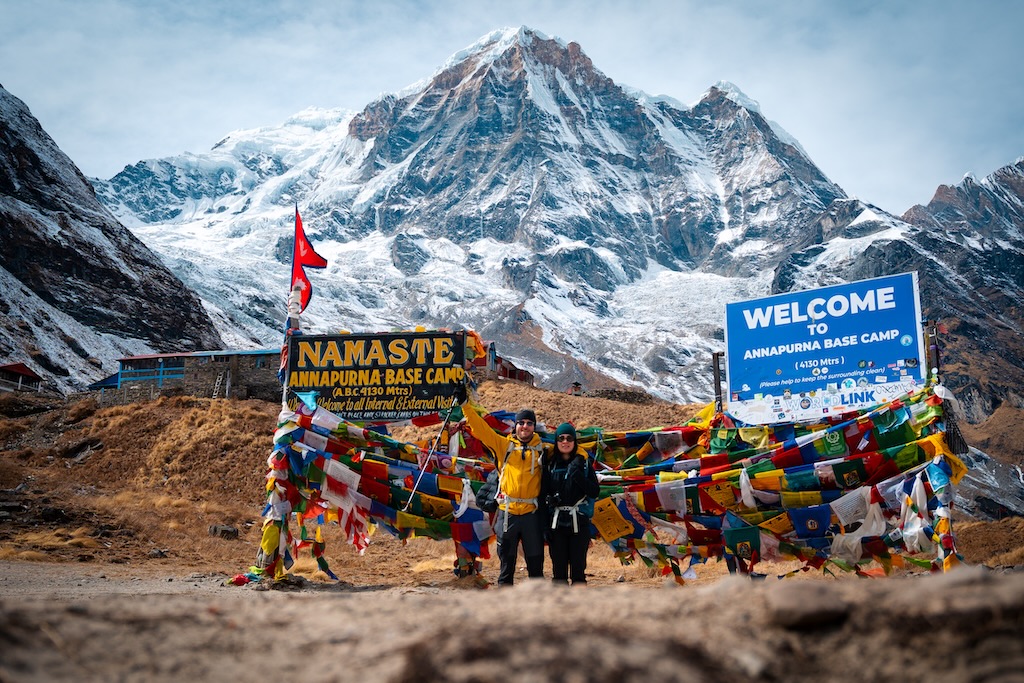
You’ll reach the landmark board at the base camp, where you can take photos, videos, and hang the prayer flags. The tea houses are a few minutes’ walking distance from the landmark board.

Upon reaching the tea house, you’ll get your room key. As you refresh, the chef prepares the lunch.

We keep you at Annapurna Sanctuary Lodge, the best tea house at the base camp.

Overnight at Annapurna Sanctaury Lodge

Included standard meals (Breakfast + Lunch + Dinner)

Trek Distance

14 km

Elevation

2,310 meters

Trek Duration

6 hours

Watching the sunrise over Annapurna is a popular activity among trekkers. Thus, you shouldn’t miss it either.

Depending on sunrise time (earlier in Spring & late in Autumn mornings), you’ll wake up at least 30 minutes before it. You can grab a cup of coffee and hike to the viewpoint, a minute away from the tea house, and enjoy the sunrise in a cool way.

After watching the sunrise, you’ll head back to the tea house and have breakfast. Meanwhile, your trek porters will prepare the backpacks for the long day walk back to Bamboo.

Since it’s mostly a downhill walk, your guide keeps the pace slow. Doing this, your knee and ankle jerk less and lowers the strain.

Four hours from Annapurna Base Camp, you’ll stop for lunch at a tea house in the Himalaya.

Upon reaching Bamboo, you’ll settle in at Green View Lodge.

Overnight at a tea house

Included standard meals (Breakfast + Lunch + Dinner)

Trek Distance

8.5 km

Elevation

1,780 meters

Trek Duration

6 hours

After breakfast at the tea house in Bamboo at 8 a.m., you’ll prepare to trek to Jhinu Danda.

Leaving Bamboo, you’ll trek for two hours to Upper Sinuwa. The first 30 minutes after leaving Bamboo are tiring with a sharp uphill climb. However, the rest of the trail is comfortable with no uphill climbs.

From Upper Sinuwa, you’ll descend to Lower Sinuwa and a river, cross a bridge, and ascend the Chhomrong.

Right after the bridge until the top of Chhomrong, its steep uphill climb on stone-paved stairs.

You’ll stop for lunch at the tea house in Chhomrong. This place offers a wholesome view of Mt. Machhapuchhre, Annapurna South, and Hiunchuli.

From Chhomrong, you’ll descend for 40 minutes to Jhinu Danda. You’ll leave your backpacks at the tea house and hike to the hot spring pool.

Returning from the Hot Spring Pool, you’ll eat dinner and hop into bed.

You’ll settle in at Hotel Park Village, the best one in Jhinu.

Overnight at Park Himalaya Lodge

Included standard meals (Breakfast + Lunch + Dinner)

Trek Distance

5 km

Elevation

2,012 meters

Trek Duration

4 hours

After breakfast at the tea house in Jhinu Danda, you’ll prepare for a four-hour amazing trek to Ghandruk.

There are many routes to Ghandruk, but we’ll trek via Uri, the best route.

Past Jhinu, you’ll cross a suspension bridge, trek to Samrong, and follow the off-road for thirty minutes. You’ll ascend for an hour along the road to Uri. From Uri, the route gets flat and trails along the motor road to Ghandruk.

Throughout the walk, you’ll get a panoramic view of Mt. Annapurna South, Hiunchuli, and Machhapuchhre.

In Ghandruk, you’ll settle in at Hotel Danda Gaun or Namaste, the best lodges in the village. These lodges are at the heart of old Ghandruk village. Moreover, the rooftop and courtyard of these lodges are best for mountain viewing.

After lunch, you’ll visit the Gurung village and explore around the old village.

Tips: The sunset from Ghandruk is the best. So, don’t miss out on watching the sunset over the Annapurna mountains.

With dinner, you’ll sign off from Ghandruk.

Overnight at DandaGaun Lodge

Included standard meals (Breakfast + Lunch + Dinner)

Drive Duration

1.5 hours

Elevation

822 meters

Morning in Ghandruk unfolds in great ways.

First, the spectacular sunrise over the Annapurna mountains. The sunrise moment excites the energy in Ghandruk.

Second, the elegant breakfast with a wholesome mountain view. The lodge provides an amazing breakfast with fresh roasted coffee.

You’ll leave for Pokhara at 11 am. With a comfortable and safe drive, you’ll reach Lakeside in two hours.

You’ll get dropped off at the hotel in Lakeside, Pokhara.

Overnight at Hotel Splendid View

Included standard meals (Breakfast + Lunch)

Trip Cost Details

Cost Includes

  • Airport–hotel transfer in Kathmandu by private vehicle upon arrival
  • One night’s accommodation in a three-star hotel in Pokhara, including breakfast
  • 10 breakfasts, 10 lunches, and 9 dinners
  • Twin-sharing accommodation throughout the trek (attached bathrooms where available)
  • Experienced, licensed trekking guide with first-aid responder certification throughout the trek (Number of guides depends on group size)
  • Porter service at a 2:1 ratio (one porter for two trekkers) Minimum of two trekkers required; porter service for solo trekkers is available as an add-on
  • Company-provided duffle bags for use throughout the trek
  • Annapurna Conservation Area Permit (ACAP)
  • Private jeep from Pokhara to Birethanti for groups of 4–5 trekkers; shared jeep from Ghandruk to Pokhara (smaller groups will use shared jeep services)

Cost Excludes

  • Personal expenses for amenities used by trekkers (Wi-Fi, hot showers, bottled water, etc.)
  • Any beverages other than tea as mentioned in the Cost Includes section
  • Any additional meals not specified in the Cost Includes section
  • Additional accommodation in Pokhara and meals other than breakfast during the Pokhara stay
  • Travel insurance is not provided and must include emergency helicopter rescue and medical evacuation
  • Porter service for solo trekkers is not included
  • Tips and gratuities for trekking guides and porters

Altitude Infograph

Altitude Infograph

Annapurna Base Camp Trek Info

Airport Pickup & Kickoff

Your arrivals in Nepal should be hassle-free, and we value that. For your comfort, NepTrek Adventures provides a complimentary airport pickup service. Our representative will be at the arrivals at Kathmandu airport to welcome you with a marigold garland.

Following the welcome, you’ll get an airport-to-hotel transfer in a private vehicle.

We strongly recommend that you arrive in Kathmandu at least a day before the trek to avoid last-minute preparations.

At the hotel, you’ll meet with our manager/trek guide for a short trek brief.

Where You’ll Stay

Our 10-day Annapurna Base Camp Trek starts from Pokhara. Thus, we’ll provide one night’s accommodation at a three-star hotel in Pokhara (twin sharing basis). Because of this, we don’t provide any accommodations in Kathmandu. However, upon request, we’ll book a boutique hotel in Kathmandu.

Throughout the trek, your accommodations will be in twin-sharing rooms (with attached bathrooms upon availability). You’ll get clean blankets, pillows, and a spacious room for accommodation. But, at most places, you have to use a common toilet that is clean and properly sanitized.

Meals on the move

You’ll enjoy 10 breakfasts, 10 lunches, and 9 dinners during your 10-day trek. You’ll get a meal menu to order your favourite meal for each course. Lodges we accommodate prepare every meal with hygiene as a priority and fresh meals. Most tea houses offer an array of meal choices and flavors for every meal, ensuring you stay energized and satisfied throughout the trek.


Transportation

Since this trek starts and ends in Pokhara, we don’t provide any transportation from Kathmandu to Pokhara and from Pokhara to Kathmandu. However, upon request (add-ons), we’ll help you with tourist bus/flight tickets (one/two way).

Based on group size, we’ll provide a shared or private jeep ride from Pokhara to Birethanti and Ghandruk to Pokhara. These are the transportation services included in the trek cost.

Porter & Luggage Limits

For your comfort, we provide a trekking porter to carry your luggage during the trek. We assign one trek porter for two trekkers. You’re allowed to assign no more than a 9 kg backpack to the porter. For this, we’ll provide you with a duffel bag (waterproof), which you must return after the trek. For any weight access of 9 kg, you must pay additional fees to the porter.

If you’re planning to bring extra luggage, we’ll help you store it at the hotel, free of charge. However, if you’re bringing any extra luggage, we suggest you inform us.

Travel Essentials

Visa

Except for Indian travelers, all other nationals must get a Nepali visa to enter Nepal. If you’re arriving in Nepal by flight, you can get an on-arrival visa at the Immigration section at the airport. Those arriving by land can get an on-arrival visa at the border. However, for some nationals, the on-arrival visas are not applicable. Your passport must be valid for the next six months. Your visa fee depends on the duration of your stay in Nepal. The minimum is 15 days.

Travel Insurance

Travel Insurance is mandatory, and it must include emergency helicopter evacuation as well. On this trek, you’ll need an emergency helicopter evacuation coverage upto 4,200 meters elevation. Things often change quickly when you’re in the mountains, and you must be well prepared for it.

Currency Exchange

For your personal expenses during the trek, you’ll need Nepali rupees. Hence, you must exchange your currency in Kathmandu or Pokhara before starting the trek. The exchange rates depend on the rate for a particular day.

Extra expenses

If you’re planning to spend on drinks, snacks, WiFi, and a hot shower during the trek, it’ll be close to USD 15 per day. Thus, for 10-days trek, USD 150-200 would be adequate.


Trek Permits

Annapurna Conservation Area Project (ACAP) is a special permit you’ll need for the Annapurna Sanctuary Trek. This permit can be obtained from the Nepal Tourism Board in Kathmandu and Pokhara.

Once you have paid the Annapurna Base Camp Trek Cost to us, we will purchase the ACAP Permit for you. You don’t have to pay additional fees for the permits. Also, we’ll purchase all necessary government paperwork and tax-related items.

Here’s what we need from you in order to issue this permit:

  • Two passport-sized photos
  • A valid passport

If you’re an individual planning for the Annapurna Base Camp Trek 10 days and don’t have an idea about the permit, we have an independent blog on the ACAP Permit. Check out our blog to learn more.

Sunset over Dhaulagiri, captured from Ghorepani
Sunset over Dhaulagiri, captured from Ghorepani (Image © NepTrek)

Annapurna Base Camp Elevation

10 The Annapurna Base Camp Trek isn’t an extreme elevation trek. As a trekker on this trek, you’ll be over 4000 meters in elevation overnight at the base camp. However, for the rest of the 9 days, you’ll be trekking through the mid-hills of Annapurna Sanctuary.

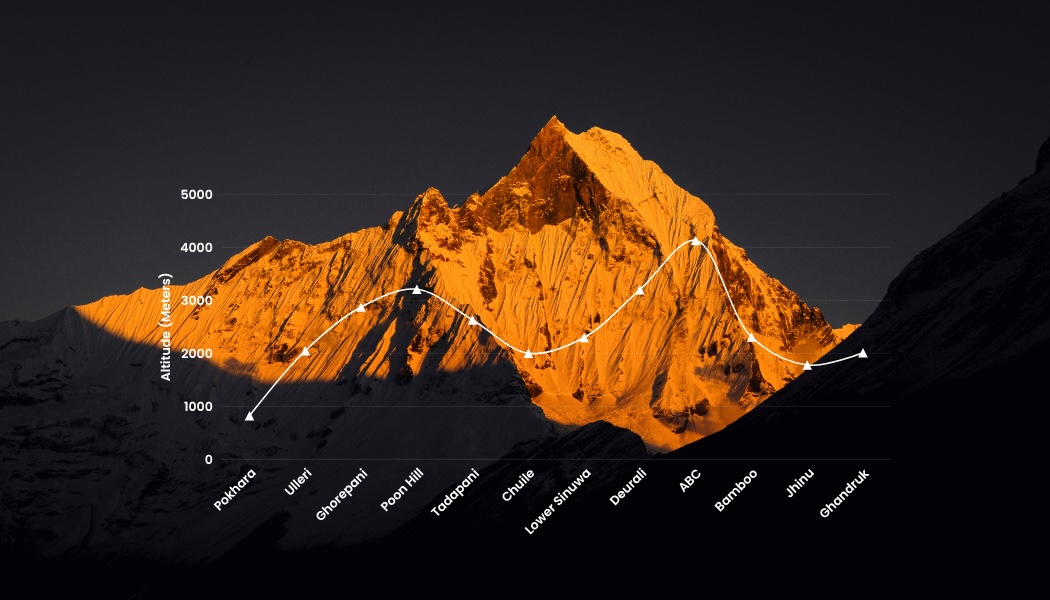
Pokhara sits at 822 meters elevation, the lowest on this trek. At 4,130 meters is the base camp of Annapurna, the highest elevation on this 10-day trek. The mid-hills elevation ranges between 2000-3500 meters.

To plan this 10-day trek, you’re advised to learn the trek elevation in detail. It gives you an idea of how the trek progresses elevation-wise.

Here’s a graph representing the Annapurna Base Camp Elevation profile.
10 days Annapurna Base Camp Trek Map and Elevation Profile
10 days Annapurna Base Camp Elevation (Image © NepTrek)

For detailed elevation guide, check out our Annapurna Base Camp Trek Elevation Guide for detailed information.

Best Time for Annapurna Base Camp Trek

Spring (March-May) and Autumn (September-November) are the perfect months to trek to Annapurna Base Camp via Ghorepani and Ghandruk. Stable weather, clear sky, and ideal temperature conditions make these times perfect for the trek.

Average temperature in the spring months at the base camp ranges from 0˚C to 10˚C. The lower regions get warmer by the start of Spring. Autumn months get colder as the months progress. The temperature decreases to near freezing during the later Autumn months.

Winter gets cold and snowy. However, this trek is doable even during the snowy winter days with winter  layering and trek gear. The tea houses remain open throughout the year.

Trekking to Annapurna Base Camp and Ghorepani in Summer is doable, but the clouds and rain ruin the mountain viewing. However, if you love freshness, greenery at higher elevations, wild-flower bloom, and crowd-free trek, July and August are the best times for this trek.

A day on the trail

The usual trek day begins with breakfast at 7-7:30 am. You’ll start the trek at 8 am. The lunch stops are usually 3-4 hours’ walking distance away. The lunch stop will be for an hour. After lunch and some rest, you’ll trek for 2-3 hours and stay at the tea house at the destination. The dinner time will not be later than 7 pm. Once you finish the dinner, your trek guide will brief you about the next day’s route, expectations, and overall feedback from the day’s walk.

Trek Difficulty

The 10-day Annapurna Base Camp Trek via Ghorepani and Poon Hill is not difficult. It’s a moderate-grade trek. Any novice trekker with reasonable physical fitness can complete it. The trekking route is full of short, steep uphill climbs, flat, and downhills. The only difficulty on this trek would be continuous trekking for 10 days, which can be tiring at times. However, with adequate physical fitness and trek preparations, one can easily conquer this trek.

Who Can Join?

This 10-day ABC Trek via Ghorepani isn’t a demanding trek. Due to this, most people, including the kids and the elderly, can embark on. Moreover, the risk of getting altitude sickness is significantly low.
Said this, physical fitness is a must. Without physical fitness, it’ll be extremely difficult to complete this trek.
At NepTrek Adventures, we have our own set of policies on who can trek. Here’s what we don’t take on the trek:
  • Pregnant women
  • Senior citizens over 70 years old
  • People with existing health issues, including blood pressure and heart issues
  • Children below 8 years old

Gears to Bring

Your trek experience is directly related to gears and clothes you wear. The basics are a must, and others are optional. What are the basics? Well, they are the layers, shells, jackets, boots, and a good backpack. Your priority for backpacking should be warm and comfortable clothes. A decent waterproof trekking boot, a waterproof soft shell, insulation layers, mid-layers, and a down jacket are a must. For the lower body, you’ll need some trekking pants, trousers, and woollen socks.

Apart from wearables, you’ll also need to bring items for hygiene and health. Body wash, toothpaste, sunscreen, a first-aid kit, and individual medications are a must. Don’t forget to bring a water bottle or bladder, whichever is more comfortable.

Read our Annapurna Base Camp Packing List for complete backpacking idea.

How to prepare for Annapurna Base Camp Trek?

Preparing for a trek involves more than just gear and backpacking. You must get your physical fitness in good shape, be mentally prepared, understand the trekking route, trek itinerary, and book the trek with an agency like us.

For physical fitness, we recommend that you do jogging, long walks on weekends, swimming for cardio, etc. Moreover, any previous multi-day hiking or high-altitude trekking is a plus, but not mandatory.

Annapurna Base Camp Trek Cost

Annapurna Base Camp Trek cost depends on your preferences. However, if you find our package perfect, it costs USD 899 for an individual. However, if you’re coming in with your group of friends and families, it’d cost you less than the individual price.

We strongly recommend that you read our ‘Cost Includes’ and ‘Cost Excludes’ sections to know what we offer at this price. However, for customization and the addition of amenities, the trek cost will increase.

Extend your adventure

The 10-day Annapurna Base Camp from Ghorepani and Ghandruk is adventurous. But, should tell you this: Nepal has more amazing places worth visiting. A Chitwan jungle safari tour or Kathmandu city tour can be an ideal choice to recharge. Or, returning to Pokhara, you could extend your stay and engage in some adventure sports like bungee jumping, paragliding, or ultralight flight.

Should you consider extending your trip in Nepal, we’ll be more than happy to create a unique experience for you at the right price.

Our Team

Our team of experienced trekking guides and cheerful Sherpa porters are ready to guide you on your dream adventure in Nepal. With extensive high-altitude experience and first-aid responder certification, they prioritize your safety, comfort, and well-being at every step, while providing friendly, professional support on the trail. Our guides and porters are well compensated, insured, and properly cared for, and this respect and support reflect in the outstanding service they deliver—something our past clients consistently praise for its warmth, professionalism, and reliability.

Tipping to the Crew

Tipping the guide and porter at the end of the trek is a common practice. It’s a way of showing gratitude for their amazing service during the trek. Tipping in a group is collective, and the amount is based on how much you appreciated their service throughout the trek.

Our amazing 10-day Annapurna Base Camp Trek package is waiting for you. And we look forward to guiding you through the amazing landscapes of Annapurna Sanctuary!

Trek FAQs

Expand all

General Information

Annapurna Base Camp Trek via Ghorepani and Poon Hill is a 10-day trek. However, time-bound adventurers, excluding Ghorepani and Poon Hill, can complete the ABC Trek in 5 days (shortest). Moreover, depending on your pace, you can complete this trek in 7 days.

Customizing ABC Trek with Mardi Himal is another great way to do the base camp trek.

The average walking distance each day is 12-13 km in 6 hours. However, there are shorter days with just 4 hours of walking. And, there are some long walking days with a distance of over 18 km in 8 hours.

 These figures might seem overwhelming, but it’ll be a comfortable walk.

Annapurna Sanctuary is legendary in many ways. The first ever 8000-meter mountain climbed was Annapurna I, which made the entire Annapurna region popular in the Western world. But it was not just because of the mountains. The unique landscapes, cultural experiences, and near-360˚ mountain panorama make this region spectacular. Moreover, the trekking here isn’t demanding, fitting every trekker and adventurer.

Absolutely. Any novice trekkers with reasonable physical fitness can embark on this 10-day adventure. The trek isn’t demanding and has very few but short, steep climbs. Moreover, the trekking routes are well-maintained and marked, with ample tea houses providing comfortable accommodations and savoury meals. On top, you’ll be guided by an experienced trek guide, supported by a Sherpa porter.

Everest Base Camp Trek is extreme high-altitude trek. Due to this, trekkers experience altitude sickness, fatigue, and find it demanding to complete the trek.

Compared to the Everest Base Camp, the Annapurna Base Camp Trek is easy to do. The landscape isn’t rugged, and there’s a faint chance of trekkers getting altitude sickness.

However, with proper physical fitness, trek preparations, and guided by experienced guides, novice trekkers can embark on the Everest trek.

Annapurna Base Camp Trek is to the South base camp of Annapurna I, from Pokhara. It involves the walk through mid-hills, hamlets, and vantage points, leading to the base camp. Moreover, it’s a moderate-grade trek.

Annapurna Circuit Trek circles around the Annapurna mountains and some glacial lakes. It starts from Besisahar and ends in Pokhara, spanning 12 to 15 days. It involves crossing a high mountain pass over 5,420 meters. The cultural experience here is unique and different from that in the base camp trek.

100% safe for international and domestic trekkers.

Nepal is a welcoming country that treats adventurers and guests with warm hospitality. As the country is tourism-focused, every adventurer and visitors are safe anywhere in the country.

Annapurna Base Camp Trek is extremely safe for international trekkers. Guided by experienced guides and well-planned logistics, you, as an international trekker, will have a fantastic time.

Absolutely. You’re more than welcome to plan your private 10-day Annapurna with Ghorepani Poon Hill Trek. If you don’t want to trek in a group, trekking privately is a great way to experience the Annapurna region.

You must understand that private treks are more expensive than doing it in a group. But that extra money you pay for the trip guarantees your utmost comfort, safety, an experienced trek guide, and a porter, all taking care of you throughout the trek.

Private trek has amazing perks. First is the itinerary customization. You can plan an itinerary in your own way. Second, you can take rest days for acclimatization at places like Chhomrong or even spend extra nights in Ghorepani. Moreover, you’ll get a private trek guide and porter, ensuring utmost safety and making the trek successful.

Annapurna Base Camp Trek with Ghorepani Poon Hill and Ghandruk offers a complete Annapurna experience. This trek trails through some amazing hamlets, vantage points, farmlands, cascading streams, dancing waterfalls, and is blessed with a spectacular panoramic Annapurna mountain view.

Most notable highlights are the Poon Hill sunrise, overnight at Annapurna Base Camp, amazing sunrise and sunset, Annapurna mountain panoramas, and a timeless cultural experience.

Trek booking and cancellations

You can book this 10-day trek through our official webpage, via email, or by contacting us through WhatsApp. Once we confirm your preferred time and availability, we’ll guide you through the trek booking process. Moreover, we’ll share all the necessary trek details, including itinerary and cost details, before confirming your spot for this trek.
We require at least 50% of the trek cost to confirm your reservation. This amount allows us to secure the trek permits, book the tea houses, hotel reservations, trek guide, and porter arrangements. You can pay the remaining amount upon arrival in Kathmandu or one week prior to the start of the trek.

Unfortunate events often lead to trip cancelation and we understand that. At NepTrek Adventures, our trip cancellation and refund policies are fair and transparent. The refund amount depends on how close to the departure date you cancel the trip. The following points highlight how our cancellation and refund policy works.

–  If you cancel the trek before a month of trek, you’ll get a 50% refund of your advance payment.
–  If you cancel the trek before a week of the trek, you’ll get 25% of your advance payment on refund.
–  If you cancel the trek before the day of the trek, you won’t get a refund. Moreover, you must pay 50% of the total trek cost as compensation.
–  If you cancel the trek for personal reasons after a few days of starting it, you won’t get a refund.
–  If you get altitude sickness and return to Pokhara, you won’t get any refund.

The trek cost generally covers accommodation, meals, hotels, guides, porters, permits, and transportation. Everything the cost covers will be provided on trek details.

However, additional expenses may include personal spending during the trip, purchase of travel insurance, drinks, snacks, hot showers, WiFi, electricity recharge, etc.

Our transactions are transparent with no hidden costs. Hence, we only provide the services that are mentioned under “Cost Includes”.

We recommend that you confirm this trek at least two months in advance. We also accept the last minute bookings. However, during the peak seasons (Spring and Autumn), the availability of guides, flights, and accommodations often decreases. Thus, to book the trek guides, flights, and accommodations along the trek, early confirmations are highly recommended.

Arrivals and Visas

Yes. With the exception of a few countries, most travelers are eligible to obtain on-arrival visas at Kathmandu airport. An immigration department inside Kathmandu airport provides on-arrival visas, with the process being straightforward.

Also, here’s a list of countries whose citizens don’t get on-arrival visas in Nepal.

Yes. We provide airport pickup upon your arrival at Kathmandu airport. This complimentary service is included with your trek booking. Our representative will be waiting for you at the airport’s arrival hall. Shortly after meeting, you’ll get an airport-to-hotel transfer on a private vehicle/taxi.
Absolutely. Once you arrive at the hotel in Kathmandu, we’ll arrange a short trek briefing session. However, if you’re tired upon arrival, the briefing will be the next day in Pokhara. The trek briefing session provides you with an overview of the trek in general, revisit the itinerary, final checks of equipment, discuss the safety measures, answering your queries, etc.
NepTrek Adventures looks after you from your arrival till the departure. We take care of all logistics, from airport pickup, hotel transfer, trek briefings, and on-ground support. While we take care of everything, you can focus all your energy on the adventure.

Transportation

The 10-day Annapurna Base Camp Trek starts from Pokhara. Hence, trekkers must travel to Pokhara independently, either by tourist bus or by flight. The good thing, our trekking guide travels from Kathmandu to Pokhara for the trek. Thus, the trek guide will accompany you from Kathmandu to Pokhara.

The trek cost doesn’t include the transportation from Kathmandu to Pokhara. However, the trek cost includes the two-way jeep from Pokhara to Birethanti and Ghandruk to Pokhara.

The trek cost ‘only includes‘ the transportation between Pokhara and the trek trailhead, round-trip. Thus, the trek cost doesn’t include your travel between Kathmandu and Pokhara (bus/flight). However, our team will assist you with flight/bus ticket bookings as optional add-ons for your seamless travel experience before/after the trek.
During the trek, we use quality local jeeps from Pokhara to the trek’s trailhead. For a group of at least five trekkers, we arrange the private jeeps. However, for a smaller group of trekkers, we organize a shared jeep. The jeep provides comfort and a safer commute, even on the mountain roads.

The trek cost ‘includes’ the pickup on arrival and ‘excludes’ the drop-off.

However, our team will happily help you with drop-off with add-ons.

Travel in Nepal, especially the flights, often gets affected by the changing weather conditions. Various factors like smog, fog, and overcast cause flight delays. During the poor weather conditions, we’ll keep you posted about the alternative arrangements, prioritizing your safety. Also, we’ll try to minimize the disruption to the itinerary so that you can enjoy the adventure as planned.4

But we won’t compromise your safety over anything. Unless the weather permits, the guide’s decision will be the final decision.

Absolutely. We always prioritize your safety. Experienced local jeep drivers drive the jeeps on the track from Pokhara to Jhinu and from Ghandruk to Pokhara. They drive the jeep on this route once a day everyday. We also choose vehicles that are in perfect working condition.
Upon request, we can organize your return from Pokhara to Kathmandu or any onward destinations. The options include tourist buses, jeeps, or flights. These services are available as optional add-ons.

Accommodation and Meals

Lodges and the tea houses are popular accommodations during the trek. The tea houses and lodges on the Annapurna Base Camp Trek route are well-established. They provide simple, clean, and twin-sharing rooms with warm bedding. At a few places, the lodges also provide attached bathrooms. Accommodation facilities at lower elevations are comfortable and are basic as you trek to higher elevations. Nevertheless, the tea houses provide a comfortable overnight experience.

All the tea houses are safe and well-organized, prioritizing the hygiene and trekker’s comfort.

Hot showers are available at every tea house, from lower elevations all the way to the base camp. A hot shower costs USD 4-5, depending on the elevation along the trek. Hot showers at higher elevations are usually expensive due to the high logistics of carrying the gas cylinders and water availability.

We advise you to take hot showers till Deurali (if taking). However, hot showers past Deurali and the base camp might cause shivers, cold, and a cough.

The hot showers are usually gas-heated. Thus, check for proper ventilation before taking a hot shower.

Attached toilets are available at very few places, such as Ulleri, Ghorepani, Chuile, and Chhomrong. However, at other places, trekkers have to use the shared toilets, which are usually clean and hygienic.

The tea houses at lower elevations provide Western-style toilets. However, higher up, squat toilets are common. You’ll get water, jet spray, and soap. We recommend that you bring toilet paper rolls and small hand sanitizers for personal hygiene.

Almost all the tea houses provide high-speed Wi-Fi. Should you consider using it, the tea houses charge a minimal fee of $2-3 for an overnight Wi-Fi use. With the recent addition of mobile network towers, trekkers can now use mobile network coverage for cellular data.

Sometimes, the weather conditions impact the availability of Wi-Fi and cellular networks.

Except at Annapurna Base Camp and Machhapuchhre Base Camp, all other places are powered with electricity. Thus, you can charge the electronic devices at the tea houses at minimal fees. Tea houses provide charging ports in the dining hall. However, the charging ports won’t be available in your room.

You’ll get three meals a day, breakfast, lunch, and dinner, all from the menu.

Tea houses provide freshly prepared, hygienic meals. You can have Nepali, Tibetan, and Western dishes. The most common meals are Dal Bhat, fried noodles, pizza, pasta, rice, soups, potatoes, eggs, and seasonal vegetables. You can also eat meat (chicken) at the lower elevations (until Dovan). However, at higher elevations, consuming meats are forbidden for religious reasons.

Absolutely. A vegetarian way is the right way to do the trekking. All the tea houses on Annapurna region provide vegetarian meals with a handful of choices. Dal Bhat with vegetable curry, soups, noodles, pizza, fries, pasta, and eggs are staple options at all elevations.
Tea houses provide running tap water for drinking purposes. However, at a minimal fee, they also sell filtered drinking water. If you wish to refill the water bottles from running water taps, we strongly recommend that you use water purification tablets. It’s because the tap water contains minerals and often causes stomach aches and other issues among the trekkers. However, you’ll see Nepali guides and porters drinking water from the taps, which for them is completely normal.

Trek Preparation & Fitness

Despite being a 10-day trek, it’s moderate. Hence, anyone with reasonable physical fitness and good health conditions can embark on this trek. Each day on this trek involves 5-7 hours of walking over the varied yet less rugged terrain. For physical fitness and preparations, hiking, jogging, swimming, yoga, cycling, and stair climbing are recommended exercises.
Prior trekking experience is a plus, but not necessary. This 10-day trek is perfect for all kinds of trekkers, from novice to seasoned trekkers. Anyone with reasonable physical fitness and a positive mindset can embark on this trek and complete it comfortably. Moreover, our experienced trek guides and Sherpa porters walk you at a steady pace, allowing time for rest and acclimatization.
As we’ve mentioned, anyone with reasonable physical fitness who can walk 5-7 hours each day for 10 days can embark on this trek. However, for different age-group travelers, we have our own policies. We don’t accept inquiries for children below 8 years or elderly over 70 years. Said this, anyone in this age bracket must be physically and mentally sound to join our groups or embark on a private trek with us. Moreover, the trekkers must provide us with their medical history if they’re on any ongoing medications.

We can’t just say no. But we can assure you that compared to other treks in Nepal, the Annapurna Base Camp Trek is the safest when it comes to altitude-related issues. The base camp sits at 4,130 meters, where the risk of getting altitude sickness is very low. But, said this, few trekkers experience some degree of altitude sickness.

We, at NepTrek Adventures, follow a strict ascent plan with a fixed itinerary, monitor your health every 8 hours, remind you about hydration, and trek gradually for proper acclimatization.

Cardiovascular fitness and leg strength are the two most important things you need to work on before embarking on this trek. Physical activities like long walks, hiking with a backpack, stair climbing, swimming, cycling, and strength building trainings are extremely helpful.

When to start preparing? We recommend that you start preparing for physical fitness at least 6-8 weeks before joining the trek.

The daily walking distance on average can be 8-15 km per day. In hours, it’s 5-7 hours.

The trekking route is amazing, and each day on the trail feels like connecting with the serene nature. Primarily, the trail includes the forest path, village trails, suspension bridges, wooden bridges, and stone-paved staircases. You can also expect some steep uphill climbs at places like Ulleri, Tadapani, Chhomrong, and Sinuwa.

Your safety will be the top priority during the trek. Our experienced trek guide(s) are trained to recognize the early signs of altitude sickness, fatigue, and other issues trekkers experience. Hence, after assessing your situation, your trek guide will adjust the pace, add rest days if needed, or arrange the descent or evacuation in accordance with your travel insurance.

Usually, we provide Sherpa porters to carry your main luggage during the trek. It ensures you walk comfortably and in ease.

All you’ll need to carry is a small daypack with personal essentials like snacks, water bottle, camera, sunscreen, etc.

Health and Trek Safety

Absolutely. Any trekking in the Annapurna region is extremely safe for female adventurers. Be it in a group or solo, any trekker can feel safe during the trek. Annapurna Base Camp with Ghorepani and Poon Hill Trek passes along well-established hamlets and tea houses. Here, everyone welcomes adventurers with warm hospitality and respect. Moreover, at NepTrek Adventures, every female trekker is assigned an experienced female trekking guide for the trek, prioritizing safety, comfort, and mutual respect throughout the journey.

Read our Annapurna Base Camp Trek Safety guide to learn more about the trek safety and more.

100%. Safety has always been our priority and driving force. We always work with highly experienced, wilderness first aid responder-certified trekking guides who have trekked to Annapurna Base Camp for years, understand weather patterns, and elevation conditions better. Our trek itineraries are meticulously prepared, assess the client’s health every 8 hours, maintain a steady pace, and practice all safety standards. We believe that a safe trek is a successful trek.

From the start of our guided trekking journey, we’ve guided hundreds of adventurers. All of them have completed the trek. Moreover, none of our clients have experienced any forms of altitude sickness, health emergencies, or injuries.

Highly no. Almost 99% of trekkers who do the Annapurna Base Camp Trek via Ghorepani and Poon Hill don’t experience any form of altitude sickness. While trekking to Poon Hill and en route to base camp, the route trails through the mixed elevations, perfectly providing acclimatization.

Moreover, Annapurna Base Camp’s elevation is 4,130 meters, which isn’t an extreme elevation. Thus, our expert-designed itinerary allows you trek gradually at a steady pace. Furthermore, our experienced trek guide monitors you at regular intervals to minimize the altitude-related issues.

Our trekking guides are experienced professionals and boast an awareness of altitude-related sickness. If you experience the altitude sickness symptoms, we:

–  Snow down or pause the trekking immediately.
–  Prioritize hydration and health monitoring.
–  Descend to lower elevations or stay at the same elevation (during nights)
–  Coordinate with your travel insurance for helicopter evacuation if required.

One thing you must understand is that we won’t push you or take you to higher elevations if you get altitude sickness.

Yes. Travel insurance is mandatory if you want to trek to ABC via Ghorepani and Poon Hill. Your travel insurance must include and cover the emergency helicopter rescue from higher elevations (up-to 4,500 meters on this trek). We require you to provide the proof of your travel insurance policy after confirming the trek.

Should there be any emergencies, our trek guides coordinate with the local authorities, rescue services, and helicopter evacuation, if necessary. With the installation of network towers, the cellular network is available at every place on the trek. Thus, our guides will be on constant communication with us and also with related authorities.

Yes. Our trekking guide carries a first aid kit box with supplies for altitude sickness, minor injuries, and other common illnesses during the trek. Moreover, our guides are Wilderness First Aid responder-certified.

We highly recommend that you bring your personal medications, as we don’t provide personal medication to clients.

Having pre-existing health conditions such as asthma, heart disease, lung issues, or previous high altitude issues, trekking to Annapurna Base Camp can be challenging. Thus, we strongly recommend that you consult with your doctor regarding the possibility of trekking with existing conditions.

We highly recommend that you inform us in advance so that we can customize the trek itinerary and make necessary arrangements.

Trek Guide & Support Staff

Beyond years of guiding experience and various certifications, our trek and tour guides are motivated individuals. They’re friendly, approachable, reliable, and someone you can trust during your adventure. Their fitness, energy, and passion for guiding amazing adventurers are unmatched. They care about you and everyone around you during the trips. Furthermore, they create a positive atmosphere, maintain utmost professionalism, and follow safety procedures throughout.

Yes. You’ll get a certified licensed trek guide and support staff for your 10 days Annapurna Base Camp Trek via Ghorepani and Poon Hill. All our trek guides are certified and licensed, with years of experience in high-altitude guiding. They’re trained on various aspects of trek, from safety to altitude awareness, first aid, client handling, and organizing an entire trek.

All the trek guides at NepTrek Adventures are highly experienced. Moreover, they have experience of trekking to most regions of Nepal, leading the clients on numerous occasions. They’re the local experts.

Our Annapurna region guides have extensive knowledge of the region, weather patterns during different months, excellent connections with the best tea houses, and an understanding of local culture. They manage every trek from start to finish, smoothly, whilst creating amazing experiences for our valued adventurers.

Absolutely. All our trek guides speak English fluently and are excellent communicators. You’ll have a seamless experience while communicating throughout the trek.

Our guides are more than happy to explain the trek route, local villages and cultures, daily trek plans, and itinerary. Furthermore, they’ll answer all of your queries and are available for support throughout the trek.

Yes. We provide trek porters (support staff) for our clients during the trek. Generally, we provide a trek porter for a group of at least two or more trekkers. However, for individual trekkers, the trek cost doesn’t include the trek porter. Thus, for individual trekkers, hiring a trek porter is subject to add-ons.

This allows you to trek comfortably without straining your back and legs.

We practice safe and ethical weight limits when it comes to backpack weights on porters. Our responsible trekking practice allows clients to assign an 8-9-kilo backpack weight per person to the porter. And, for every additional weight, trekkers are subjected to add-ons.

To avoid unnecessary backpacking, we’ll provide you with a backpacking guide. It helps you to pack essentials for the trek and avoid unnecessary stuff.

The number of trek guides and porters depends on the number of trekkers and group size. Usually, we assign one guide to a group of five trekkers. However, for more, we assign assistant guides, aligning with the guide-to-client ratio.

The trek porter (support staff) number also depends on the group size and the client’s special requirements. For example, some groups prefer trekking without a porter guide. However, we assign 1:2 (porter:trekkers), in groups with two or more trekkers.

Yes. Guides at NepTrek Adventures are wilderness first-aid certified. Moreover, they’re experienced high-altitude responders. Trek guides regularly monitor trekkers’ health, diagnose any signs of altitude sickness, and act responsibly. Moreover, they communicate with authorities during emergencies.
Guides are more than a group leader. They manage daily logistics, coordinate meals and accommodation, lead the group, set the pace, and explain the cultural interactions along the way. Moreover, they also motivate and support the trekkers so that they gain confidence throughout the trek.
Tipping is voluntary and is not mandatory. However, trek guides and porters appreciate it as a gesture of gratitude for their excellent service. Tipping can be collective for a group, and the amount depends on how satisfied you feel with their services.

Backpacking & Gear

If you’re an individual trekker and not hiring a trek porter, you’ll need at least 60 litres of a backpack to carry essential clothes and gear. However, while trekking in a  group, you’ll need a 30-litre daypack. It should be perfect to carry daily essentials such as water bottle, snacks, gadgets, a jacket, and personal items. As most of your backpack goes into the duffel bag, carried by porters, you can trek light and more comfortably.
Yes. Your assigned trek porter carries your main backpack throughout the 10-day trek. We provide waterproof duffel bags for the porters to carry your stuff. With the main backpack carried by the porter, you’ll have a comfortable trek throughout.

Our trek porters carry 8-9 kilograms per trekker. This is the limited weight bracket for any trekker, and they can assign only this weight. Thus, for additional weight, the trekker has to carry themself or pay additional fees to the porter.

Given a porter, our clients can trek comfortably with their main luggage bring carried by the porter. However, we also ensure that our porters can trek comfortably with a lighter backpack.

Essential clothing items are, but not limited to:

–  base layer (thermal)
–  warm insulated layer (jacket/fleece)
–  wind and waterproof outer layer
–  stretchable and breathable trekking pants
–  warm trekking socks
–  down jacket
–  beanie, gloves, neck buff, etc.

Layering is the key when it comes to clothing. Thus, instead of thick jackets and hoodies, thin yet multi-layer clothes are highly recommended.

For complete backpacking idea, we suggest you to read our detailed Annapurna Base Camp Packing List Blog.

Not really. A pair of comfortable, waterproof trekking boots with ankle support and grip is enough for this trek. If you’re planning to get a high-end trekking boot, that’s completely amazing. However, if you have running shoes with better grip and fits your foot well, it’ll help you complete the trek.

Make sure that the boots have been used several times before. With brand new boots, it’ll be difficult to adjust to the steps for the first few days.

While tea houses provide blankets and beddings, a sleeping bag provides extra warmth and comfort. Moreover, during late Autumn and early Spring months, a good-quality sleeping bag provides cozy overnight sleep.

We recommend you bring a sleeping bag rated -10˚C.

If you prefer to rent a sleeping bag, we’ll help you rent one from our trusted stores.

Yes. You can rent most trekking gear at the trekking gear shop in Kathmandu. You can rent a sleeping bag, a down jacket, trekking boots, and trekking poles. Renting the gear is convenient if you live at humid regions or are just embarking as a one-time adventurer.

We suggest you use personal gears instead of renting the gears for the sizes, conditions, and hygiene.

Absolutely. Once your trek is confirmed, we’ll email you a detailed backpacking checklist. Moreover, our backpacking checklist is tailored to 10 days ABC Trek via Ghorepani and Poon Hill.

Weather, Temperature, and Best Time

For the ultimate Annapurna Sanctuary Trek experience via Poon Hill, Spring (March to May) is the best time. The primary reason is that the rhododendron blossoms in March and April make the landscape elegant. Not to mention, the clear weather and warm temperature make trekking to Annapurna Base Camp in Spring the best.

Autumn, from late September to late November, is the best time for this trek. Clear weather, moderate temperature, rain-free days, and a wholesome mountain panorama make the walk the best.

If you’re okay with a few leech bites and don’t bother carrying a raincoat, the Annapurna Base Camp Trek in July and August is the best. You’ll walk along the misty forests, wildflowers, pastures, and beautiful hamlets. You may not get the clear weather morning at the base camp for mountain viewing. However, you’ll surely admire the ten days trek via Poon Hill.

Despite the cold, trekking to Annapurna Base Camp via Poon Hill in winter is also a good time.

Conclusion: Spring and Autumn are the most beautiful times for Annapurna Base Camp Trek. However, Summer and Winter are also the best times for this trek.

The weather and temperature at Annapurna Base Camp depend on the time you trek. However, you can expect clear weather, gentle temperatures, rain-free days, and beautiful mountain scenery.

We have individual blogs that cover the topic of weather and temperature at Annapurna Sanctuary throughout the year. Check our weather and temperature blogs on September, October, November, April, and March.

Usually, the weather clears during the morning and evening at these places throughout the year. Even during the rainy summer days, you’ll get clear weather in the morning.

Autumn and Spring months are the busiest time for Annapurna Base Camp Trek via Poon Hill. And in these months, the weather remains 100% clear with a crystal clear viewing experience.

Probably. If the weather conditions are severe for trekking, we won’t trek further. However, on usual minimal rainfall or snowfall, communicating with local authorities, we’ll proceed further.

Oftentimes, the heavy snowfall makes the trek challenging. Moreover, the continuous rainfall washes the wooden bridges at Deurali and en route to Machhapuchhre Base Camp. Hence, under such conditions, we prioritize your safety and adjust the itinerary if needed.

Microspikes are essential during snowy months. When it snows, the trail gets slippery with ice and snow. Hence, to avoid a slippery walk, microspikes are a must. They help you walk firmly and avoid any slippery sections, preventing possible injuries.

From Our Guests
Unforgettable journeys, told by those who lived them!

10 Days
USD 799PP
Group-Size Discounts
**Discounts are solely based on your group size. We do not add anyone to your group.

Talk to an Expert

Kiran Neupane
Saroj Dahal

Connect with our expert for tailored itineraries or schedule a virtual consultation to get more insights.

REACH ON WHATSAPP
Speak to an Expert